Königsplatz
In 1934/35 Klenze’s classicist forum is turned into the NSDAP’s central parade ground — the “slab lake” where books burned and the “blood witnesses” of the movement lay. After the Honour Temples were blown up in 1947, four decades as a car park; lawn again since 1988 — and a site of reckoning since 2015.
- “A German place” — Köpf’s reading and the painter of Königsplatz
- Before 1933 — the classicist forum
- The remodelling 1934/35 — Troost and 20,000 granite slabs
- Expulsion — “The old people must get out”
- The Honour Temples and the 16 “blood witnesses”
- Book burning — 10 May 1933
- The Nazi cult: 9 November and Day of German Art
- Demolition and “slab lake” — 1947 to 1988
- A democratic square and the dispute over remembrance
- Today — lawn, concerts, reckoning
- Quotes
- Sources
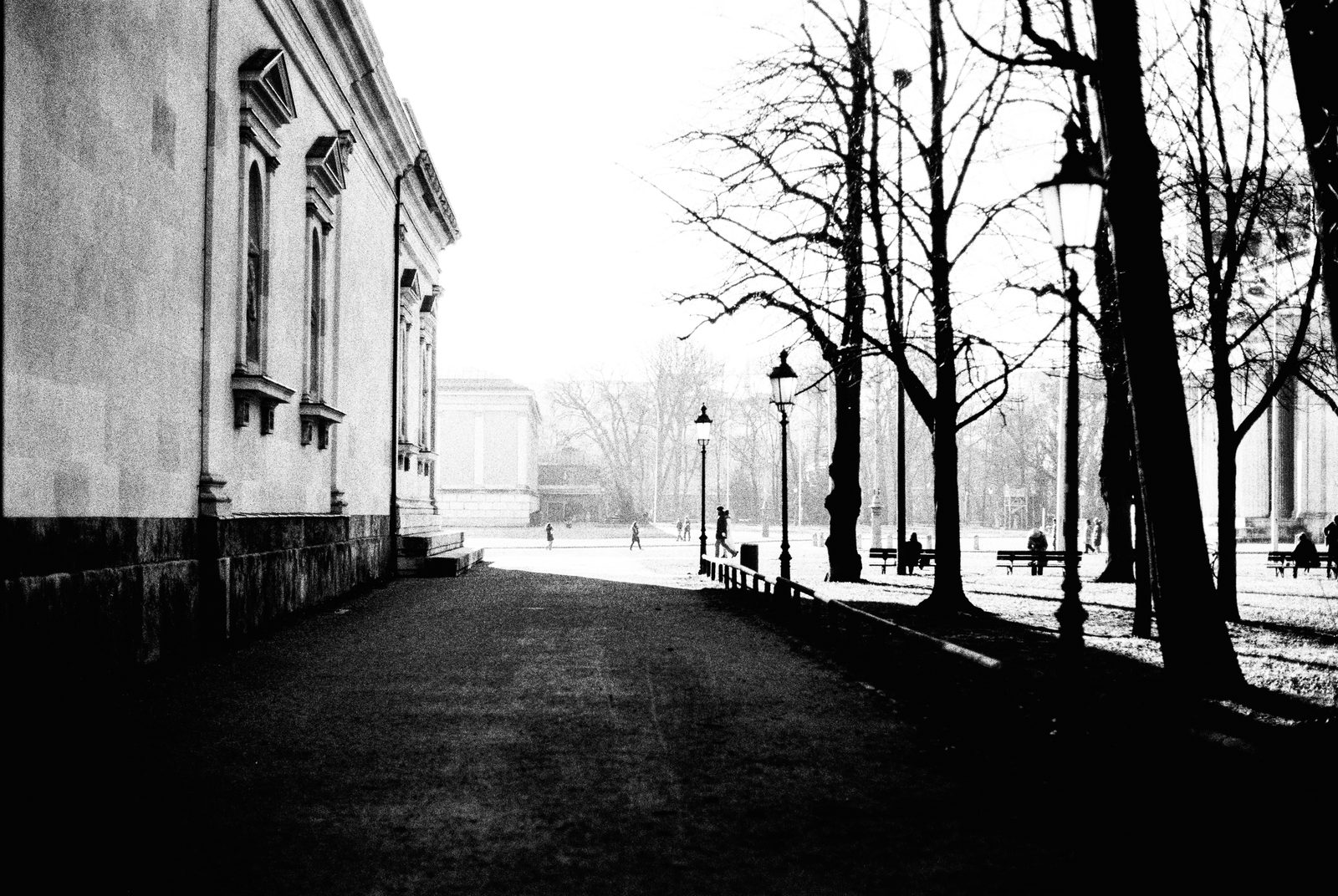
A German place.
The journalist Peter Köpf reads Königsplatz as a lens on German history: one and the same square is the classicist forum of the monarchy, a völkisch place of longing, a Nazi cult site, a post-war car park and, finally, a place of remembrance. Not a single rupture but a chain of reinterpretations — hence the subtitle “A German place”.
The painter of Königsplatz
Köpf opens with a scene from early summer 1913: a jobless young man, twice rejected by the Vienna Academy of Fine Arts, stands at his easel on Königsplatz painting the Propylaea. The Ingolstadt teacher Friedrich Echinger strikes up a conversation and buys a watercolour of the Propylaea from him for little money — 21.2 × 34.9 cm. The painter is Adolf Hitler; he has lived in Munich since May 1913, scraping by on views of well-known buildings. He would later write of the city’s “wonderful marriage of primal force and fine artistic mood, that singular line from the Hofbräuhaus to the Odeon, from the Oktoberfest to the Pinakothek”. (Köpf, p. 13)
The twist: Leo von Klenze, the architect of the square, also painted the Propylaea — in 1848, years before construction began, to show his king the planned gateway. The creator of the forum and its later re-interpreter, both at the same motif. (Köpf, pp. 11, 13)
“Forum of Germandom” — already before Hitler
The square’s ideological appropriation did not begin only in 1933. Around 1900, when the grown city of Munich had enclosed the once-peripheral Königsplatz, the idea was already circulating of turning the supposedly “unfinished” forum into a national place of consecration and heroes — a “Forum of Germandom” complete with halls of honour. Hitler’s architects later built on designs that völkisch precursors had long formulated. (Köpf, chapter “Hitler’s precursors”, pp. 49 ff.)
Klenze’s forum
When King Ludwig I was crown prince in 1815, he met the young architect Leo von Klenze in Paris. A few years later that encounter became an urban programme: Munich was to become Bavaria’s Athens. Königsplatz is its centrepiece. Glyptothek (Klenze, 1816–1830) to the north, State Collections of Antiquities as its counterpart (Georg Friedrich Ziebland, 1838–1848) to the south, Propylaea as a western gateway (Klenze, 1854/1862) — three buildings that quote ancient Greece and recall the Bavaria–Greece link through Ludwig’s son Otto, King of Greece 1832–1862.
The square itself was no paved expanse in the 19th century but a two-part green space with gravel paths, lawns and trees — an idea in which Friedrich Ludwig von Sckell, the creator of the English Garden, was probably involved. Brienner Straße cut through the middle. Anyone entering the square was meant to walk between antiquity, art and remembrance — educated middle-class culture as a building programme.
Paul Ludwig Troost
Born 1878 in Elberfeld. Hitler’s “first architect” before Albert Speer. In 1933 he is commissioned to redesign Königsplatz and to build the Führerbau, the Administrative Building and the two Honour Temples. He dies on 21 January 1934 in the middle of the planning phase. His studio — led by his wife Gerdy Troost and his collaborator Leonhard Gall — completes the buildings by 1937.
20,000 granite slabs
In 1935 the green space is removed entirely. In its place around 20,000 square granite slabs are laid, each roughly 99 × 99 cm and 10.6 cm thick. The stone was deliberately sourced from several regions — Black Forest, Odenwald, Fichtelgebirge — the symbolic message: the “whole Reich” is building together. The forum becomes a stone parade ground.
From forum to parade ground
What Klenze had conceived as a quiet classicist stage set embedded in green, Troost turns into a strict, empty granite square. Trees, lawns, gravel paths — all of it gone. Along the edges the Nazi regime places flagpoles and pylons. The square is closed to car traffic; Klenze’s classicist buildings (Glyptothek, Propylaea, Antiquities Collections) become backdrop — literally pushed to the margins by the new Nazi monuments on the narrow sides.
Along the eastern axis, towards Arcisstraße, four buildings rise in symmetrical succession between 1933 and 1937: north of Brienner Straße the NSDAP Administrative Building, south of Brienner Straße the Führerbau, and in front of them — on Brienner Straße itself — the two Honour Temples. Together with Königsplatz they form the geometric centre of Hitler’s “Capital of the Movement”.
“The old people must get out”
Around the square lay an established quarter of grand bourgeoisie and artists. With the remodelling, the NSDAP bought, seized or expropriated the plots on Brienner- and Arcisstraße and had splendid town houses torn down to make room for the party complex. Among the most prominent residents were Alfred and Hedwig Pringsheim — he a mathematics professor of the Bavarian Academy, she a women’s-rights campaigner; their daughter Katia had been married to Thomas Mann since 1905. Their Neo-Renaissance palace at Arcisstraße 12 was seized in 1933 as “Jewish” and had to make way for the Führerbau.
On 24 June 1933 Thomas Mann noted in his diary: “The old people must get out, so that the house they lived in for 40 years may make way for yet another of the extravagant party palaces of which this whole quarter is soon to consist.” During demolition the party salvaged the famous Hans Thoma frieze from the music room and exhibited it as a “loan from Munich private ownership” in the Stuttgart Staatsgalerie. The compensation is said to have amounted to around 700,000 Reichsmark; the neighbouring house at Arcisstraße 14, owned by the Guggenheimer family, also passed to the party administration. (Köpf, p. 91 f.)
The “temples” and their dead
The two Honour Temples are erected on Brienner Straße between Königsplatz and Karolinenplatz — open stone pier halls without walls, facing the square. Architect: Troost; executed after his death by Gerdy Troost and Leonhard Gall. Inaugurated on 9 November 1935, the 12th anniversary of the Hitler Putsch.
Eight bronze sarcophagi are placed in each temple — sixteen in total, for the sixteen dead of the failed putsch of 9 November 1923 at the Feldherrnhalle. Nazi staging calls them “blood witnesses of the movement” and makes them the core of a pseudo-religious liturgy. Telling is position no. 8: Karl Kuhn, a head waiter who stepped out in front of his café, out of curiosity, was hit — and now, posthumously, figures as a martyr of the movement.
The 16 names
Felix Allfarth · Andreas Bauriedl · Theodor Casella · Wilhelm Ehrlich · Martin Faust · Anton Hechenberger · Oskar Körner · Karl Kuhn · Karl Laforce · Kurt Neubauer · Klaus von Pape · Theodor von der Pfordten · Johann Rickmers · Max Erwin von Scheubner-Richter · Lorenz Ritter von Stransky-Griffenfeld · Wilhelm Wolf.
“Eternal watch”
Sentries of the 1st SS Standarte “Deutschland” stand in the temples day and night. Strict immobility — the standing order, it is said, was that the guards were “not even to shoo away a fly”. Every year on the eve of 9 November a torchlight procession marches from the Feldherrnhalle to Königsplatz; Hitler reads out the names of the 16 dead — “Last Roll Call” — and the assembled answer each in turn with “Here!”. Alongside the Nuremberg party rallies, it is the most important ritual event of the Nazi calendar.
One night in May
The German Student Union’s “Action against the un-German spirit” culminates on 10 May 1933 in coordinated book burnings in 22 German university cities. In Munich it begins at 11:30 p.m. Main organiser is Karl Gegenbach, a law student at LMU and Gauleiter of the German Student Union in Bavaria. Speakers include Hans Schemm, Bavarian Minister of Education, and Kurt Ellersiek, “Elder of the German Students” (later a senior SS officer). Several LMU professors take part openly.
A torchlight procession of about 3,000 students moves from LMU at Geschwister-Scholl-Platz through the city centre to Königsplatz. There, according to Nazi figures, 70,000 spectators gather; serious estimates put the number at 50,000 to 70,000. Pyres blaze on the square; the Horst Wessel song and other Nazi marching songs ring out. Books are burned by Bertolt Brecht, Lion Feuchtwanger, Sigmund Freud, Erich Kästner, Heinrich Mann, Erich Mühsam, Erich Maria Remarque, Anna Seghers, Kurt Tucholsky, Stefan Zweig — and many others.
Four days earlier, on 6 May 1933, the Hitler Youth had staged a smaller advance action here. Speeches were given by Emil Klein (HJ regional leader Munich) and city schools councillor Josef Bauer. 10 May was the organised main performance — Königsplatz was the ideal site for this staging: large, iconic, right in the middle of Klenze’s forum for education and art.
The rituals.
- № 019 November · “Last Roll Call”
- № 0210 May · Book burning
- № 03“Day of German Art”
- № 04SS swearing-in
- № 05State receptions
- № 06Mass rallies
Where Klenze had imagined a forum, a parade ground now lay.On Königsplatz after 1935
The classicist idea — antiquity, art, the educated middle class — is overlaid under Troost by a strictly axis-symmetrical, paved choreography for the masses. Klenze’s buildings remain standing but become mere backdrop.
January 1947
In January 1947 the US Army blew up the rising architecture of the two Honour Temples — as a denazification measure. Sources cite either 9 or 16 January; conclusive evidence is missing. The sarcophagi of the 16 “blood witnesses” were already empty by then: in 1945/46 US forces had had the bodies returned to their original graves, removing them from Nazi veneration.
The plinths of the Honour Temples — the square stone plateaus on Arcisstraße — were not blown up. They remain standing. Deliberately. Anyone setting foot on Königsplatz today walks past them.
“Slab lake”
Königsplatz itself remains, after 1947, in the stone state Troost left it in. The 20,000 granite slabs stay in place. In 1961 it is officially opened for car traffic; in vernacular it is mockingly called “Plattensee” (slab lake) or the “royal car park of the economic miracle”. For four decades cars park here between Klenze and the Nazi plinths. An open discussion about reckoning with the site does not begin until the late 1970s.
In October 1986 the Munich city council passes the resolution to redesign — preparations had been running since 1981. Landscape architect Hans Heid drafts a restoration that brings back the 19th-century state “as far as possible”: eight lawns, gravel paths, no trees in the historic arrangement — a compromise between remembrance and re-greening. In 1987/88 the granite slabs are removed. Some are reused — as paving for footpaths in the municipality of Gräfelfing, for example. The Munich City Museum keeps one original slab.
A democratic square — and a lasting dispute.
A rally ground again — “Bread not weapons”
As early as 1948 the granite-paved square was once more a stage for politics, now under democratic auspices. On 1 May tens of thousands demonstrated with trade-union banners; the slogan was “Bread not weapons”. On 8 August 1948 West Berlin’s mayor Ernst Reuter spoke here in solidarity with the blockaded city; on 25 August 100,000 protested against “price-gouging” after the currency reform. In 1968, at the May Day rally, students mingled with the unionists carrying images of Ho Chi Minh, Mao and Marx. That Minister-President Franz Josef Strauß staged a Bundeswehr “Grand Tattoo” on the square on 6 November 1980 deliberately courted echoes of the pre-1945 era. (Köpf, pp. 144 ff.)
From “slab lake” to lawn
Already in 1966 Hans Zech, in his polemic “A new Königsplatz”, demanded an end to the “barbarism of Hitler’s slab lake”, the banishing of cars and parades and — in the spirit of “eternal Greece” — even the lighting of the 1972 Olympic flame here. Yet the car park remained “irreplaceable” for another two decades. Only in 1987 were the roughly 20,000 granite slabs lifted and sold to an entrepreneur from Passau (around 200,000 DM); today they pave footpaths in Friedberg near Augsburg and in Gräfelfing, among other places. (Köpf, pp. 148 ff.)
“Do not build, but reflect”
Why did it take until 2015 for a documentation centre to stand on the square? Köpf traces decades of deadlock: in 1988/89 the Munich city council unanimously called for a “house of contemporary history” on the site of the “Brown House” — the Free State of Bavaria let the proposal lapse. An ideas competition ended in stalemate; the art historian Norbert Huse argued for preserving the temple plinths as a visible “fault line” of Munich’s history, and condensed the dispute into the formula “Do not build, but reflect!” So for a long time — nothing happened. Instead small initiatives kept the memory alive: since 9 November 1995 the artist Wolfram P. Kastner has burned a black mark into the lawn every year — a reminder of the book burning. (Köpf, pp. 159 ff.)
The square today
Since the 1988 restoration Königsplatz is green again — eight lawns, gravel paths, a place to wander in the middle of the city. In summer Königsplatz Open Air programmes it with classical concerts and large pop and rock acts (Hans Zimmer, Solomun and others), as does the Open Air Cinema with premieres and classics. Political rallies and demonstrations take place here; in everyday life students and tourists lie on the lawn.
The plinths
The two plinths of the demolished Honour Temples stand on Arcisstraße — on the northern one a small biotope has grown over the decades: shrubs, brambles, birds. The overgrowth is not accidental but part of the Munich reckoning consensus: don’t demolish, don’t restore, just let them stand — as a deliberate in-between state. To this day there is no official inscription on site explaining the function of the plinths. The debate about whether this is right has gone on for decades.
NS-Dokumentationszentrum & “Rubble and Honour”
Since 30 April 2015 — the 70th anniversary of Munich’s liberation — the NS-Dokumentationszentrum stands directly on Königsplatz. The white cubic building by Georg Scheel Wetzel Architekten deliberately sets itself apart from monumental Nazi architecture. Permanent exhibition “Munich and National Socialism”, free admission. In 2022 the house showed the installation “Rubble and Honour” by the SCHULTERSCHLUSS initiative (Christian Springer, 23 March – 18 April 2022) — maritime fenders as a symbol for the decades-long “don’t touch me” attitude towards the plinths.
Sixteen dates.
The painter
The young Adolf Hitler sells a watercolour of the Propylaea on Königsplatz — Köpf’s prologue to “A German place”.
Glyptothek
Klenze’s first building on the square is completed — the foundation of Ludwig I’s classicist staging.
Propylaea
Klenze completes the western gateway — Königsplatz is now complete as an ensemble.
NSDAP commission
Troost is commissioned to redesign the square and build the party complex.
Expulsion
The Pringsheim Palace (Arcisstraße 12), home of Thomas Mann’s parents-in-law, is seized and makes way for the Führerbau.
Book burning
The Munich student union organises the burning. 70,000 spectators on the square.
Troost dies
Studio Troost (Gerdy Troost, Leonhard Gall) carries out the plans.
20,000 slabs
The square is paved. Klenze’s lawns disappear.
Honour Temples
Inauguration. 16 bronze sarcophagi. The SS “eternal watch”.
Führerbau
Inaugurated on the occasion of Mussolini’s state visit.
Demolition
US Army blows up the Honour Temples. The plinths remain.
Bread not weapons
The square is a rally ground again — this time of democracy. Ernst Reuter speaks in solidarity with blockaded Berlin.
Car park
Königsplatz is officially opened to cars — the “Plattensee” (slab lake).
Re-greening
Landscape architect Hans Heid largely restores the square — eight lawns.
Burn mark
Wolfram P. Kastner first burns a black mark into the lawn — an annual reminder of the book burning.
NS-Dokumentationszentrum
Opens on the 70th anniversary of the liberation. A place of remembrance on the square.
Words.
“The site originally dedicated to art became the stage for parades, propaganda celebrations and the National Socialists’ pseudo-religious cult of the dead, observed annually on 9 November.” — NS-Dokumentationszentrum Munich · Self-description of the historic site Königsplatz
“The sentries were not even allowed to shoo away a fly.” — Tradition about the SS “eternal watch” at the Honour Temples
“The NSDAP party quarter in the heart of Munich, with Königsplatz at its centre, was both symbol and command centre of the Nazi dictatorship.” — NS-Dokumentationszentrum · Encyclopaedia entry “Party Quarter”
In the vicinity.
on Arcisstraße
The plinths of the Honour Temples blown up in 1947 — deliberately neither removed nor explained. A “biotope on a Nazi plinth”.
Hitler’s Munich seat, Munich Agreement 1938, Central Collecting Point, today the University of Music and Performing Arts.
On the site of the “Brown House” — since 30 April 2015. Permanent exhibition “Munich and National Socialism”.
Further reading.
- / ANS-Dokumentationszentrum · Königsplatz
- / BNSDOK · Book burning 1933
- / CWikipedia · Königsplatz Munich
- / DHistorical Lexicon of Bavaria · Königsplatz
- / EWikipedia · Blood witness of the movement
- / FMunich City History · Granite slabs 1935
- / GMunich City History · Demolition 1947
- / Ht-online · “Plattensee” 1947–1988
- / ISCHULTERSCHLUSS · “Rubble and Honour” 2022
- / JMunich City Museum · original slab
- / KWikimedia Commons · Königsplatz
- / LPeter Köpf · Der Königsplatz in München. Ein deutscher Ort
Back to
the map of
all nine sites.
Königsplatz, Honour Temples, Führerbau, Administrative Building, NS-Doku, Schelling-Salon, Osteria, Prinz-Carl-Palais, Consulate General — the Nazi-era topography of Maxvorstadt at a glance.