Pinakotheken
Three Pinakotheken, a Glyptothek, a Brandhorst, a Lenbachhaus, an NS-Doku — the art quarter on Briennerstraße is one of the world's densest museum regions, with a chronological arc from antiquity to the present.
The Königsplatz
Leo von Klenze shaped the Königsplatz designed by Karl von Fischer according to his own ideas. Next to his Glyptothek, completed in 1830, he placed the Propyläen — a pseudo-Greek city gate at Munich's then western edge, corresponding to the Siegestor of his rival Friedrich von Gärtner. Instead of a museum as a city gate in the north, a gate as a museum in the west.
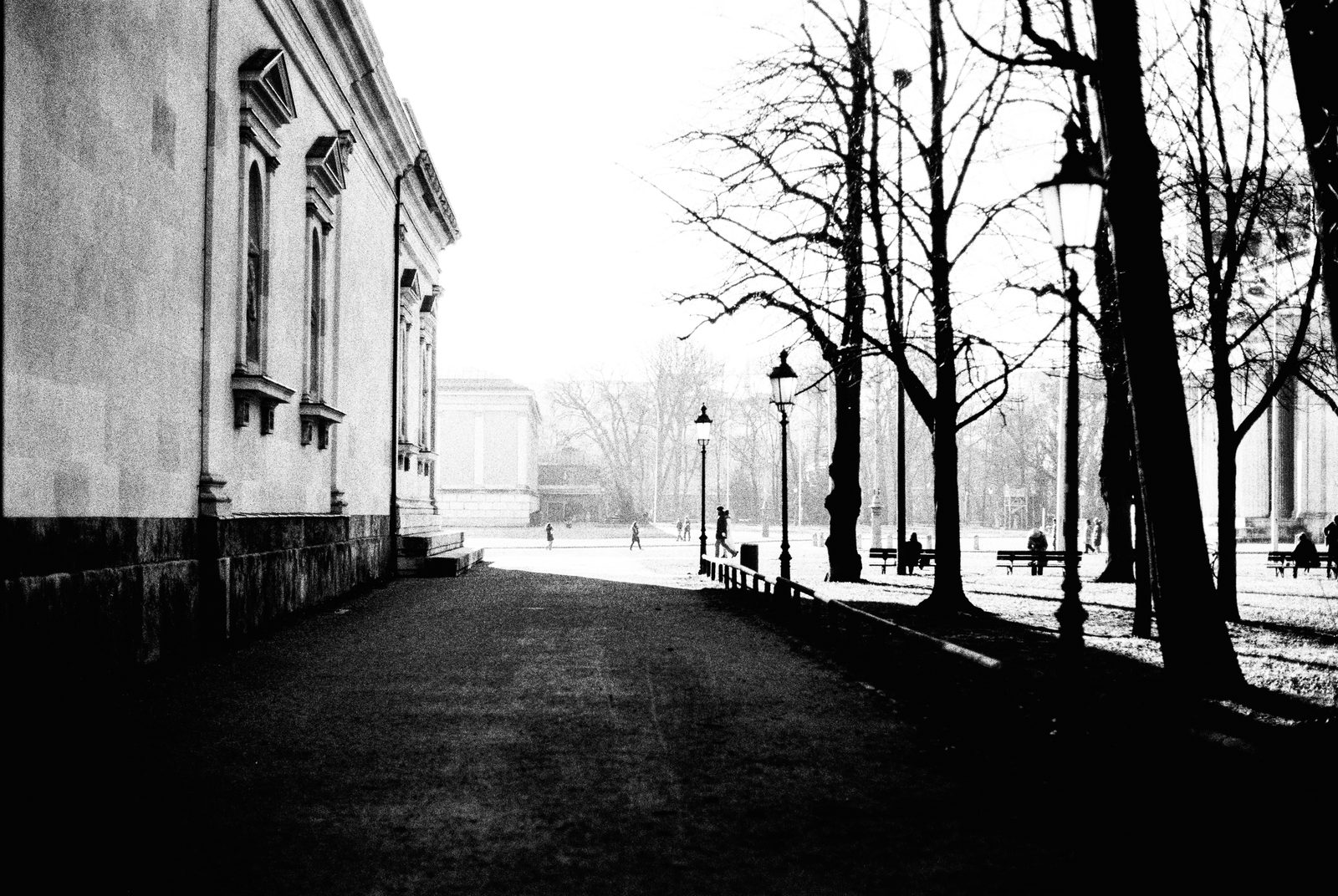
Opposite the Glyptothek, the State Collections of Classical Antiquities were later built. The Königsplatz was conceived as an ensemble from the start — until the National Socialists had it paved with granite slabs in 1937 and framed it with two "Temples of Honour" plus the administrative buildings of the NSDAP. Since the 1980s the square has been re-greened; the Nazi-era buildings partly still stand (today: University of Music and Performing Arts, music school, depots of the State Antiquities Collections).
The three Pinakotheken
Klenze built the Alte Pinakothek in 1826 — in the middle of an open meadow. It was to have a palace format and to house the growing Wittelsbach painting collection. Klenze experimented here with the effect of overhead lighting and set architectural standards for galleries worldwide. Today it houses European painting from the 13th to the 18th century: Dürer, Cranach, Titian, Rubens, Rembrandt, Velázquez.
The Neue Pinakothek has been complementing the collection with 19th-century works since 1853/2003. The Pinakothek der Moderne opened in 2002 on the site of the former Türkenkaserne barracks — uniting art, architecture, design and works on paper under one roof.
Brandhorst & Lenbachhaus
The Museum Brandhorst (2009) shows contemporary art with a focus on Cy Twombly, Andy Warhol, Damien Hirst — in a building of 36,000 coloured ceramic rods (Sauerbruch Hutton).
The Lenbachhaus — the former villa of the "painter prince" Franz von Lenbach — preserves the world's most important collection of the Blaue Reiter, with works by Kandinsky, Münter, Marc, Macke, Jawlensky, Klee. The new building by Foster + Partners (2013) supplements the historic villa with the Kunstbau (in the Königsplatz U-Bahn station).
The Kunstareal
The museums the Maxvorstadt gathers have an official name: the Kunstareal München. On an area of just 500 × 500 metres between Königsplatz and the Pinakotheken, museums, exhibition halls, universities and cultural institutions sit closer together than almost anywhere else — kunstareal.de calls it "Europe's largest cultural cluster" and sums it up in the formula art × culture × knowledge = experience³.
The count starts in 1826: that year Klenze began building the Alte Pinakothek, and the LMU arrived in Munich — which is why the Kunstareal celebrates its 200th anniversary in 2026. The idea was institutionalised only late: in 2010 the Pinakothek der Moderne foundation, under the patronage of Duke Franz of Bavaria, established the Förderkreis Kunstareal, uniting 13 friends' associations; city and state have been developing the quarter together ever since. Since 2013, the biennial Kunstareal-Fest has brought over 300 events to 40 venues, with free admission to all museums. Since 2016, the 21 cylindrical wayfinding steles by designer Nitzan Cohen have marked the area in the streetscape.
Practical matters
Best reached by U2 to Königsplatz or bus line 100 (the "museum line") — the area has no car park of its own. On Sundays, admission to the state museums costs just 1 euro; under-18s always enter free. Entirely free of charge: the NS Documentation Centre, the Museum of Casts of Classical Sculptures, the Geological and Palaeontological Museums, the Amerikahaus and St. Boniface's Abbey, as well as all galleries in the area. Most museums are closed on Mondays.
Museums
of the Maxvorstadt.
- № 01 Alte Pinakothek
- № 02 Neue Pinakothek
- № 03 Pinakothek der Moderne
- № 04 Museum Brandhorst
- № 05 Lenbachhaus & Kunstbau
- № 06 Glyptothek
- № 07 State Collections of Classical Antiquities
- № 08 NS Documentation Centre
- № 09 State Museum of Egyptian Art
- № 10 TU Munich Architecture Museum
- № 11 Deutsches Theatermuseum
- № 12 Paläontologisches Museum
- № 13 Museum Mineralogia
- № 14 Museum of Casts of Classical Sculptures
- № 15 Geological Museum
- № 16 Türkentor
External links · Please check opening hours and admission with each museum directly.
Explore
in advance.
- → 01 360° tour
- → 02 Kunstareal Walks
- → 03 Guided tours
- → 04 Folding map (PDF)
- → 05 Calendar & pulse newsletter
Source: kunstareal.de · Kunstareal München office
Eine Stadt machen,König Ludwig I. von Bayern · 1825
die Deutschland
zur Ehre gereichen
soll.
Read on
The opening volume of the Maxvorstadt series explores the district’s identity between “Kunst-Areal”, “Museum Quarter” and an organically grown cultural place — with an urban-history lead essay by Klaus Bäumler, a survey of literary life 1850–1968 and a chapter on Protestant Maxvorstadt.