Franz
Höllriegel
King Ludwig's stonemason. Glyptothek, Königsplatz, Ludwigstraße, Alte Pinakothek, Walhalla, Hall of Liberation, Hall of Fame — the Classicist city stands on his blocks. "Whoever looks at Munich's Classicist buildings is walking on Höllriegel's stones."
- A life in four stations
- In Klenze's team — Glyptothek & Königsplatz
- The buildings — what stands today on his stones
- Properties in Munich — Müllerstraße, Ludwigstraße, Lehel
- Höllriegelskreuth — founding a place
- Family — Josepha, Barbara and seven surviving children
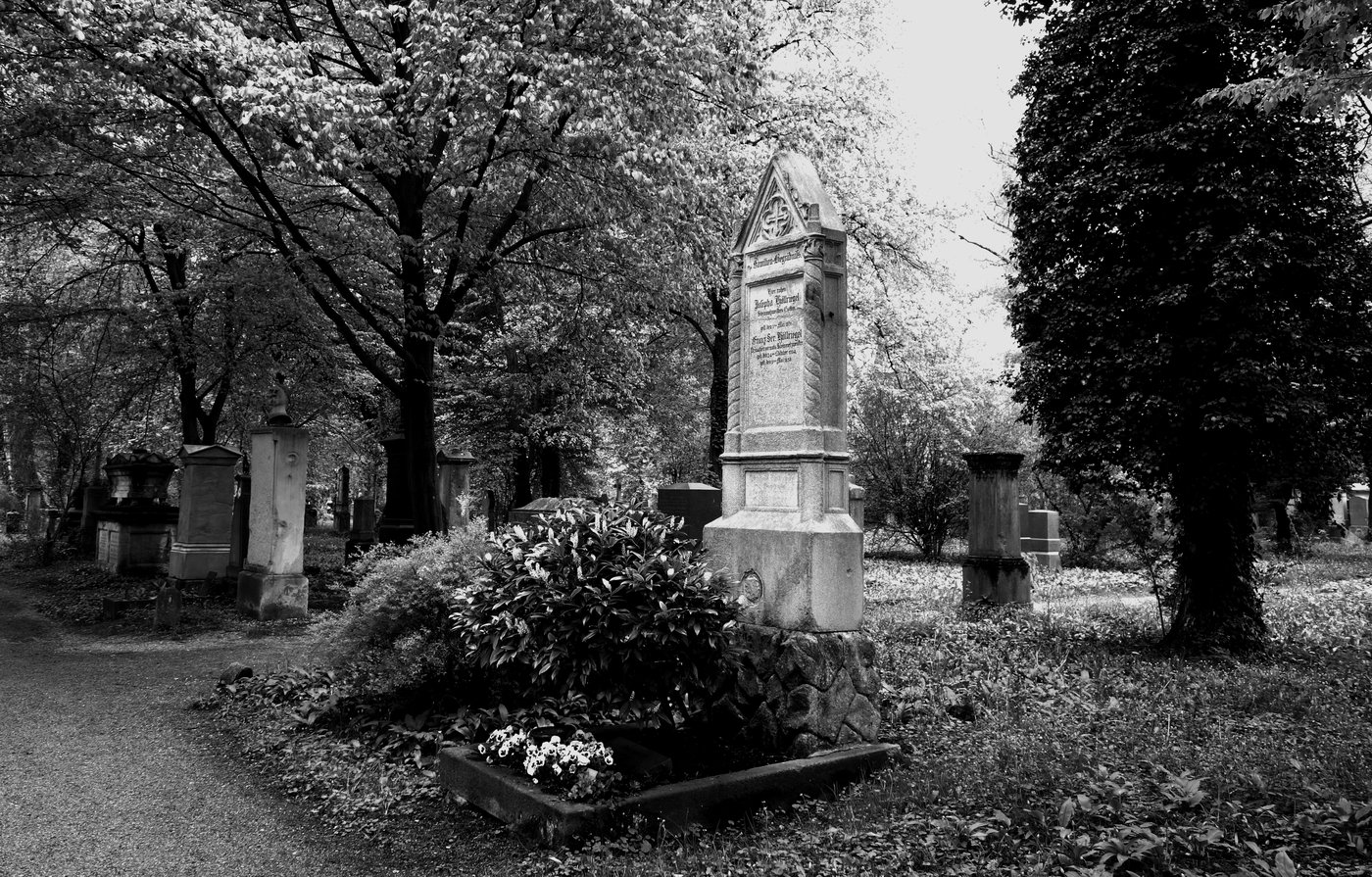
- Death 1858 — Grave in the Old South Cemetery
- Quotes
- Sources
A life in four stations
Donzdorf, 1794. Franz Seraph Höllriegel was born on 24 October 1794 in Donzdorf near Ulm — first son of master mason Joseph Höllriegel and his wife Katharina Klaus. His grandfather and father had come from South Tyrol to Swabia with other Tyrolean builders in the course of Count Maximilian Emanuel von Rechberg's palace and church works. When his father died in 1808, Franz was just under thirteen, a half-orphan.
Stuttgart, from 1812. Unlike most stonemasons of his time, Höllriegel did not just go on the road, but completed a regulated four-year apprenticeship with Stuttgart master stonemason Georg Arndt — paid for by his Donzdorf patron, Count Rechberg. There he learned, as he later wrote in his licence application, "stonecutting, drawing, arithmetic and applied geometry".
Munich, 1816. Count Rechberg had meanwhile become Bavarian Interior Minister — and recommended his protégé to Leo von Klenze, court architect to Ludwig I. Klenze brought him in as stonemason foreman on the Glyptothek building site. In 1820 Höllriegel applied for a licence of his own; on 8 February 1822 it was granted "in the name of His Majesty the King of Bavaria". On 30 August the same year, aged 23, he became a citizen and master stonemason of Munich.
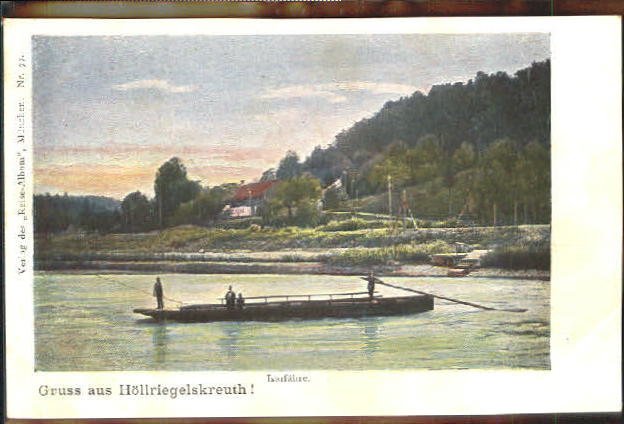
Höllriegelskreuth, 1841–1858. In twenty years the foreman became the largest stone supplier to the royal buildings. In 1841 he bought the Sedlmayer-Hof on the Isar above Pullach; by the time of his death he had expanded it to around 110 hectares. In 1852 King Max II. permitted him to name the place "Höllriegels Gereuth" — today's spelling Höllriegelskreuth is a later corruption. He died on 9 May 1858 in his house at Müllerstraße 46c.
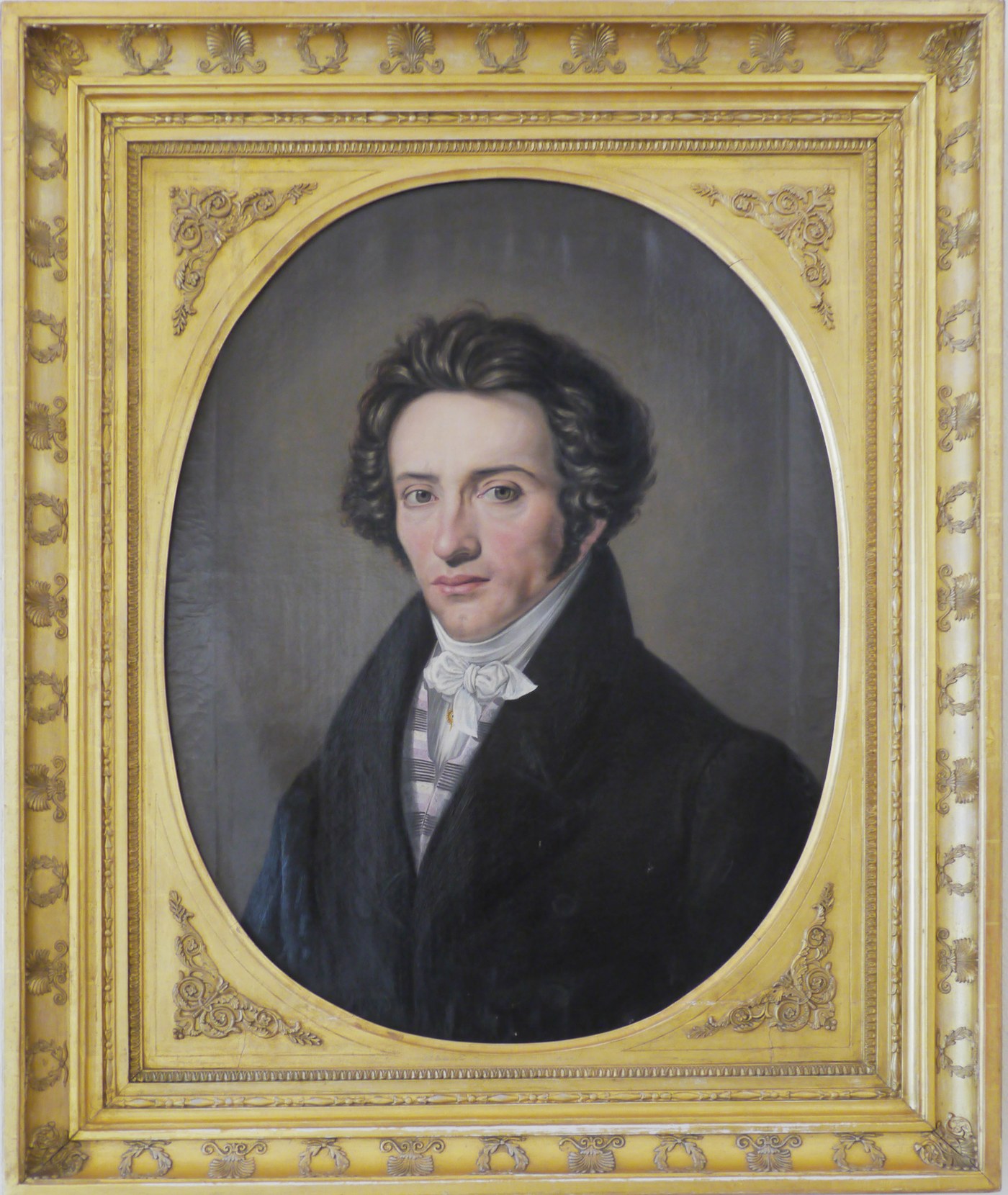
Leo von Klenze
Born 1784, Bavarian Court Building Director from 1815. Glyptothek, Königsplatz, Propyläen, Alte Pinakothek, Leuchtenberg Palace, southern Ludwigstraße. Brought Höllriegel to the Glyptothek in 1816 — and issued him the certificate in 1820 that opened the door to his own licence.
Anton Ripfel
Born 1794 in Schlanders in the Vinschgau, the same year as Höllriegel. Both Tyroleans, both from Klenze's Glyptothek team. Ripfel — the white stonemason (marble, sandstone). Höllriegel — the black (basalt, granite, conglomerate). On completion of the Glyptothek a poem honoured "The fame-crowned names Klenze-Ripfel". Ripfel died impoverished in Munich in 1850; Höllriegel systematically built up workshop and material base.
Glyptothek, Königsplatz, Siegestor
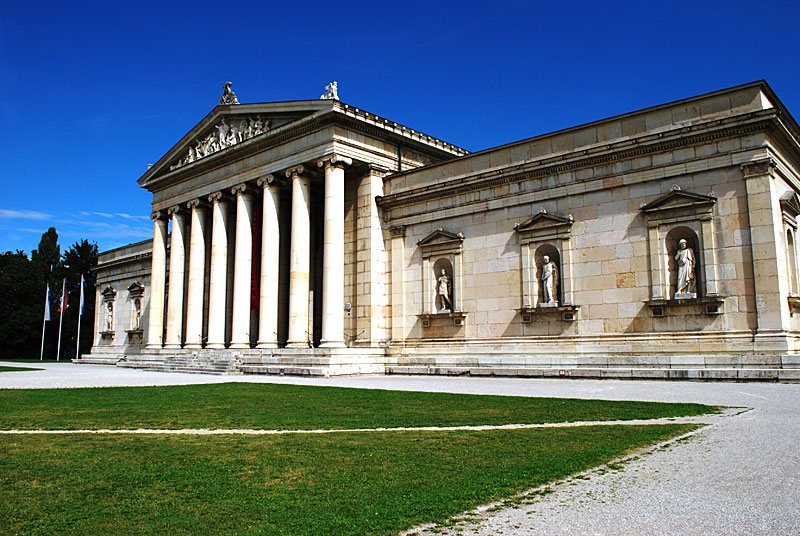
Höllriegel's first construction site is the Glyptothek (1816–1830) — he works there as stonemason foreman under Klenze. Together with Anton Ripfel he then takes responsibility for the stonemasonry of the further buildings around Königsplatz and at the Siegestor. Klenze runs Ludwig I.'s programme of making Munich an "Isar-Athens" — Höllriegel and Ripfel deliver the blocks.
That Bavarian kings liked to stage classical antiquity and buildings was known to contemporaries and later generations alike. That behind it stood two Tyrolean stonemasons and their teams was only worked out by local historians like Fritz Lutz. "Alongside these greats of art history," Lutz wrote in 1985, "the many craftsmen who helped realise the ingenious plans of the famous architects are too easily forgotten."
Workshop, quarry, material flow
Höllriegel's business is, in modern terms, vertically integrated. Quarries in Höllriegelskreuth (conglomerate), Deisenhofen (sandstone), near Rottenbuch and Neudorf near Kempten — plus, as a gift from Ludwig I., a basalt quarry of his own in the Danube valley with which he supplied the Walhalla building site. The stone-saw and polishing mill at Gewürzmühlstraße 3 on the Trift canal handles pre-processing; the 'stonemason-wares factory' in the rear building Müllerstraße 47 handles finishing. Up to 260 workers — predominantly Italian — were at times employed in the quarries.
The buildings.
- № 01Glyptothek
- № 02Königsplatz & Propyläen
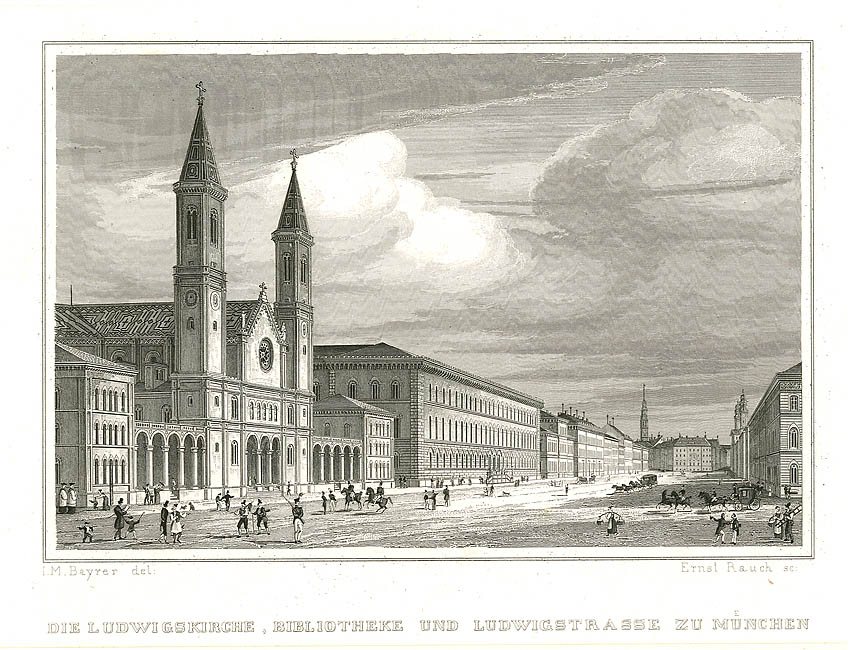
- № 03Ludwigstraße
- № 04Haslauer-Block / Ludwigspalais
- № 05Ludwigskirche (St. Ludwig)
- № 06Alte Pinakothek
- № 07Royal stables
- № 08Hofgarten arcades
- № 09Residenz
- № 10Allerheiligen Court Church
- № 11St. Bonifaz Abbey Church
- № 12Walhalla
- № 13Hall of Liberation
- № 14Hall of Fame & Bavaria statue
- № 15Ludwig Bridge & Maximilian Bridge
- № 16Großhesseloher Bridge
Müllerstraße — workshop and home
In the Glockenbach quarter Höllriegel owned the houses 45, 46a, 46b, 46c, 46e and 47. In the rear building number 47 was the Stonemason-Wares Factory, the main workshop — almost certainly the source of the black and white marble obelisks at the Old South Cemetery. In 1854 the family moved from house 47 to the neighbouring 46c, where Franz Höllriegel died on 9 May 1858. House 46a, built in 1844 by Max Kuppelmayr in a Romanesque-revival style, today bears the number Müllerstraße 39 and still shows on its façade a neo-Gothic relief with a crowned Mother of God and Christ as Ruler of the World — a small, typical Höllriegel signature.
Ludwigstraße 27 — Haslauer-Block
The property at the corner of Ludwigstraße/Schellingstraße, opposite the Ludwigskirche he helped build, was part of the complex named after Joseph Anton von Haslauer — Klenze's first composition of three houses into a unified Florentine Renaissance-revival grand façade. In August 1841 Höllriegel received permission for a building measure; after his death the house passed to his daughter Kreszenz Stangassinger. The building was destroyed in the Second World War and reconstructed after 1945 by Erwin Schleich; today the university uses it.
Lehel — Gewürzmühlstraße & St. Anna
At Gewürzmühlstraße 3 on the Trift canal, Höllriegel ran the water-powered stone saw with grinding and polishing mill — the precursor to his Müllerstraße workshop. In 1857 he sold it to his son Franz Xaver. He had acquired St. Anna-Straße 14 and 15 in Lehel at the beginning of his career; the factory building at No. 15 passed to Franz Xaver on 30 September 1852.
Dienerstraße 21 — today's Kaufhaus Beck
The house immediately neighbouring the famous Dallmayr building — on Marienplatz opposite the town hall — also belonged to the estate. Son-in-law Ferdinand Scotzniovsky sold it on 29 December 1888 for 500,000 gold marks to the merchant couple Friedrich and Frieda Rosner. Today it is part of the northern wing of Kaufhaus Beck.
Hildegardstraße 5
Daughter Kreszenz Stangassinger sold the large rear building on the side street parallel to Maximilianstraße in October 1856 for 22,000 gulden "to His Majesty King Max II. Joseph". Today the lot lies behind the Münchner Kammerspiele.
Die Ludwigstraße ist in weiten Teilen ein Werk von Franz Höllriegel.Inschrift am Brückenwirt · 1848 · „Erbaut v. F. Höllriegel"
Höllriegel's stone blocks stand from the Hofgarten to the Siegestor, from Königsplatz to the Theresienwiese, from Walhalla to the Hall of Liberation.
The purchase — 12 February 1841
On the high left bank of the Isar, opposite Grünwald castle — where a ford had crossed the river since Celtic times and the Wittelsbachs built their castle in 1292 — stood the Sedlmayer-Hof as an old customs and police station. Höllriegel bought it on 12 February 1841 from Johann Scheidt and his four sons: 178.37 Tagwerk of land — barely half a Tagwerk of courtyard, 53.4 Tagwerk of arable, 121.13 Tagwerk of woodland — for 10,400 gulden. Earlier he had already secured the local conglomerate quarry. By 1858 he expanded the holding to around 330 Tagwerk, a good 113 hectares; the quarries at times employed up to 260 mostly Italian stonemasons.
The naming — 8 June 1852
On 19 April 1852 Höllriegel submitted the application to name the estate "Höllriegels Gereuth" — until then it had been nameless. On 8 June 1852 King Maximilian II. approved the request. "Gereuth" is the old form of "Reut", the clearing; from "Gereuth" later came "kreuth", the present form being a corruption of the late 19th century. Local historian Karl Schmitt calls this day "the birthday of today's Höllriegelskreuth".
The park — chapel, monopteros, Marian column
Between 1852 and 1858 Höllriegel laid out a small English landscape garden on a hectare-sized forest plot south of the economy building — set into the beech slope, with a sightline to Grünwald castle. Lea Heinz's diploma thesis (TU Munich 2005) calls it "unique in its kind and design as the private garden of a Munich burgher": through the wild river landscape, through the slope position — and through the density of religious elements that has no second example in Munich.
- Höllriegel Chapel (1852). Neo-Gothic on a projecting conglomerate rock, with an "Ecce Homo" relief, a lamentation scene and a third marble relief showing compass, set square, hammer and unfurled plan — "here the artist and the patron identify themselves". Until 1949 an annual procession climbed up on the anniversary of his death; in 1981 the chapel passed to the municipality of Pullach, and it was rededicated on 12 May 1983. Today a listed monument.
- Monopteros (1854). Six columns modelled on Klenze's English Garden temple, a point de vue towards Grünwald Castle. Removed in 1963 because of disrepair; E.ON secured the conglomerate-rock foundation in 2003.
- Andachtskreuz (1855). Gusseiserner Korpus, Inschrift „Errichtet von Franz Höllriegel 1855", mit Betbank aus weißem Tuffstein. 2003 instand gesetzt.
- Marian Column (1858). White limestone, inscription "Erected by Franz Höllriegel 1858". The figure of the Virgin was destroyed by a bomb hit in the Second World War; E.ON re-erected the column in 2003.
- "Bierhütte" (beer hut). A two-storey house of conglomerate blocks, leaning against a four-metre rock face. On the rock, a roof garden with an oriel; according to Kurt Granel this oriel was "King Ludwig I's favourite spot during his visits".
Inscription on the donor plaque
„(German original retained, see image)"
After Höllriegel
His youngest son Albert inherited the estate including the quarries in 1858 — 248.38 Tagwerk worth 33,000 gulden — and the Munich property at Müllerstraße 45c (44,000 gulden). Albert was no stonemason; from 1873 he sold off everything except the main house (today's "Brückenwirt" inn) and the "Bierhütte". At the end of the 19th century Jakob Heilmann assembled holdings along the Isar and founded the Isarwerke; from 1894 the Höllriegelskreuth power plant ran, from 1903 the first air-separation plant of Linde AG. Today the essential part of the site is again in municipal hands; in November 2019 Pullach reopened the Höllriegel-Park.
Josepha & Barbara Keller
On 3 February 1823 Franz Höllriegel married, at the parish church of St. Peter in Munich, the still under-age Josepha Keller, daughter of a master butcher from the Ries village of Marktoffingen — the Nördlingen district court had to approve the marriage. On 7 May 1831, just 29 years old, she died of pulmonary suppuration. On 20 February 1832 Höllriegel then married her younger sister Barbara Maria Keller — six days earlier the magistrate had exceptionally permitted the brother-in-law marriage. Barbara outlived her husband by 18 years and, through her "business acumen" (Karl Schmitt), expanded the family's holdings; she died in 1876.
The children
From the first marriage (Josepha): Franz (1824–1829, died young), Kreszenz Josepha (1825–1897, ⚭ first Hofstetter, then Stangassinger; inherits Ludwigstraße 27), Joseph (1826–1826), Ludwig Nikolaus (1828–1858, takes over the master-stonemason licence in 1854, dies seven months after his father with no descendants), Franz Xaver August (1830 – after 1874, marbled-paper manufacturer and stonemason, buys Gewürzmühlstraße and St. Anna).
From the second marriage (Barbara): three children die very young, then Albert Alfons Alois (1839–1877, heir to Höllriegelskreuth) and the youngest daughter Barbara Anna Maria (1842–1909). In 1862 she married Commerce Counsellor Ferdinand Georg Scotzniovsky, tenant and commercial director of the Royal Porcelain Manufactory Nymphenburg from 1862 to 1888. Two daughters came from this marriage, Barbara and Emanuela — both married into the Tölz family Eisenberger; after the early death of her first husband Ludwig, Barbara married his brother Eugen.
In the neighbourhood of the family grave
At the Old South Cemetery — section 6/1/5253 — the grave lies next to the Pschorr family and diagonally opposite Carl Spitzweg. Urban history in stone.
Eight dates.
Donzdorf near Ulm
Geburt am 24. Oktober. Vater Joseph Höllriegel, Maurermeister mit Südtiroler Wurzeln, in den Schloss-Umbauten des Grafen Rechberg tätig. Die Mutter Katharina Klaus überlebt ihren Mann um 34 Jahre.
To the Glyptothek
Recommended by Count Rechberg to Klenze. Begins as foreman stonemason on the construction site of the Glyptothek on what would become Königsplatz.
Citizen and master stonemason
8 February: trade licence granted. 30 August: master's examination passed and admission as a citizen of Munich. Aged 23.
Marriage at St. Peter
3. Februar Heirat mit Josepha Keller aus Marktoffingen. Bis 1830 fünf Kinder; Josepha stirbt 1831 an Lungenvereiterung.
Brother-in-law marriage
20 February: marries Barbara Maria Keller, the younger sister of his deceased Josepha. Seven further children follow from this marriage; only Albert and Barbara reach adulthood.
Sedlmayer-Hof on the Isar
12. Februar Kauf für 10.400 Gulden. Aus 178 Tagwerk werden bis 1858 ca. 330 Tagwerk / 113 Hektar.
"Höllriegels Gereuth"
8 June: granted permission by King Maximilian II. The chapel is built the same year. Monopteros, devotional cross and Marian column follow by 1858.
Death on Müllerstraße
9. Mai 1858, Müllerstraße 46c, 63 Jahre alt. Beisetzung am 11. Mai im Alten Südlichen Friedhof, Sektion 6/1/5253.
Words about him.
„When we think of King Ludwig I., the creator of 'Isar-Athens', the names of his famous architects come to mind. Alongside these greats of art history, the many craftsmen — including in construction — who helped realise the ingenious plans of the famous architects are too easily forgotten." — Fritz Lutz · 1985
„The Höllriegel-Park is unique in its kind and design as the private garden of a Munich burgher. In Munich and its surroundings no other example can be named that takes up this design device and makes it a main theme of the garden layout." — Lea Heinz · Diplomarbeit TU München 2005
„On a Classicist marble pillar in the Hofgarten, on a sandstone relief in an ornate Munich townhouse, on a wind-blown wayside cross high above the Isar — everywhere in Munich and its southern hinterland, those who look closely will encounter traces of a man whose name most Münchners today only remember from a tongue-twister: Höllriegelskreuth." — Thomas Prüm · Buchentwurf, 2026
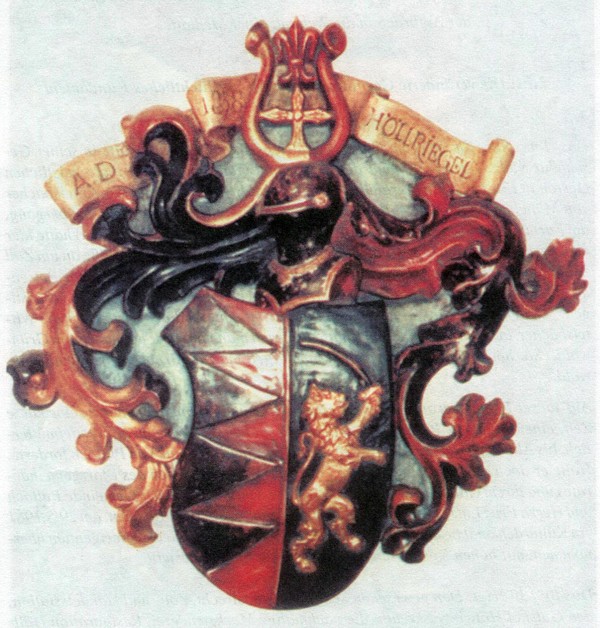 Höllriegel family coat of arms
Further reading.
- / Awww.franzhoellriegel.de
- / BLea M. Heinz · „Auf den Spuren von Franz Höllriegel"
- / CLea M. Heinz · „Der Höllriegel-Park in Pullach"
- / DKarl Schmitt · „Höllriegelskreuth"
- / EFritz Lutz · „Anton Ripfel und Franz Höllriegel"
- / FKurt Granel · "Höllriegelskreuth"
- / GWerner Ebnet · „Sie haben in München gelebt"
- / HWikipedia · Franz Höllriegel
- / IWikipedia · Höllriegelskreuth
Anyone who knows
a lead, please share it.
The source situation on Franz Höllriegel is scattered. We welcome any additional anecdote, building record or family source.