NS-Dokumentationszentrum
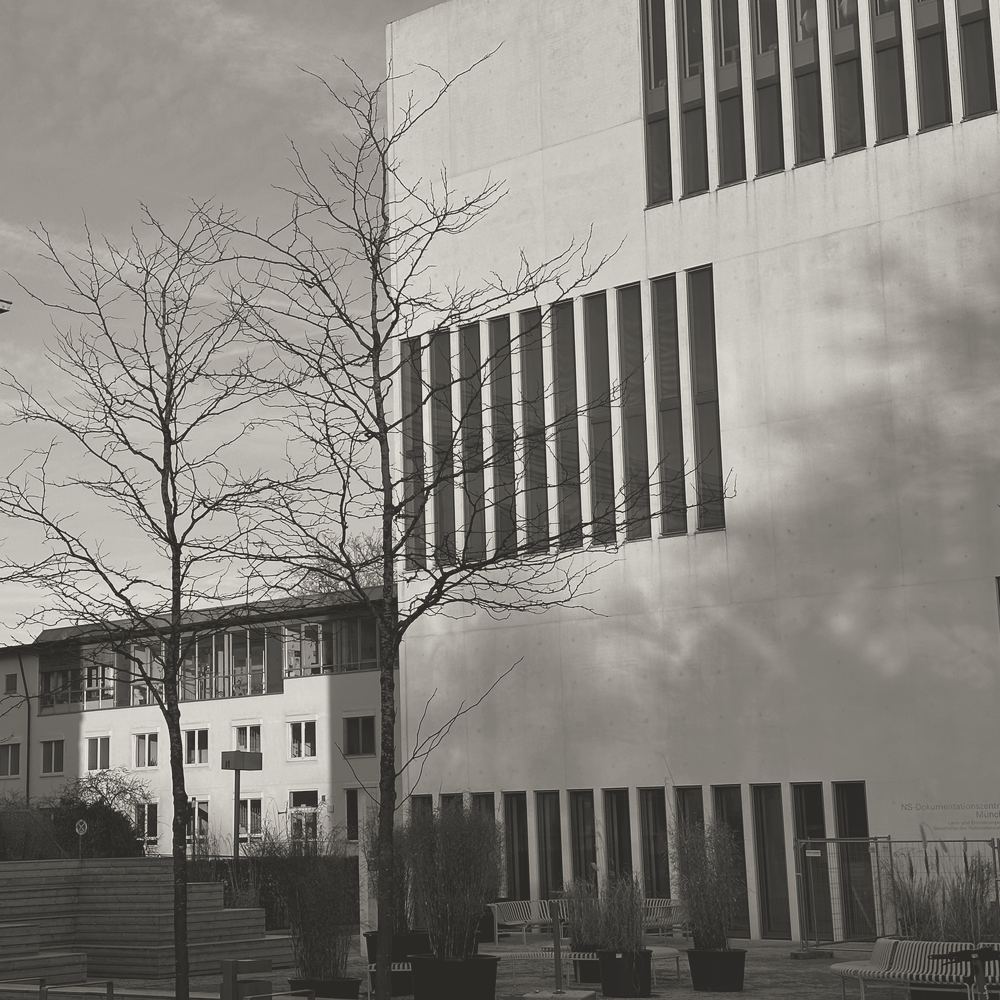
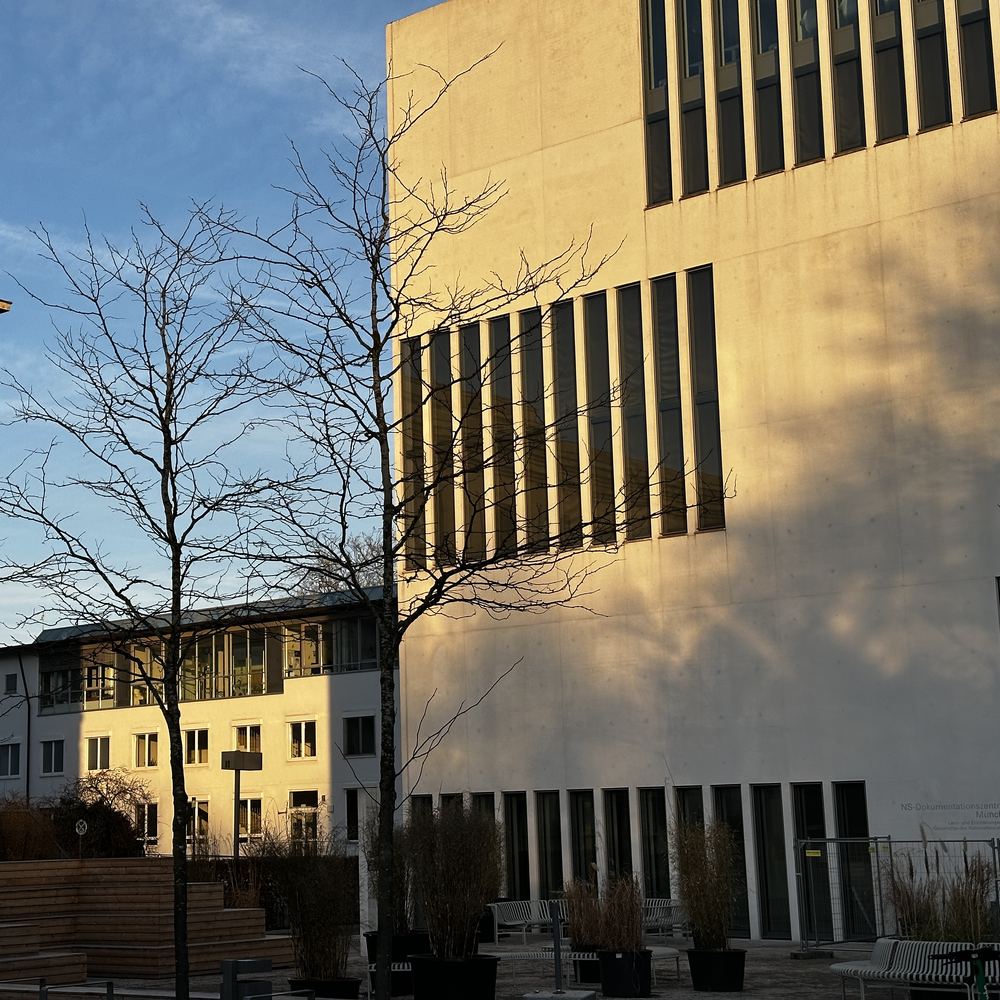
On the site of the Brown House — the NSDAP party headquarters from 1931 — the NS-Dokumentationszentrum has stood since 30 April 2015. A white cubic building that deliberately sets itself apart from monumental Nazi architecture. Free admission. Four floors, 1,000 m² of permanent exhibition “Munich and National Socialism”.
Bourgeois prehistory
On Brienner Straße the Palais Barlow has stood since 1828 — a classicist town palais by royal Bavarian court architect Jean-Baptiste Métivier, a pupil of Karl von Fischer. Three storeys, a central projection, plain and elegant.
The history of its residents runs through the whole 19th century: first Baron Carl von Lotzbeck (rented), in 1838 sold to Marchese Fabio Pallavicini, Sardinian chargé d’affaires at the Bavarian court. In 1866 court photographer Joseph Albert acquires the house, in 1876 the English merchant Richard Barlow — the palais has carried his name ever since. It passes to his son Willy Barlow.
26 May 1930 · NSDAP purchase
For 805,864 gold marks the NSDAP buys the Palais Barlow from Elisabeth Barlow, Willy Barlow’s widow. The purchase price is largely covered by industrial donations — Fritz Thyssen and other early backers of Hitler. Architect Paul Ludwig Troost converts the villa into an office building. It is his first major commission for the NSDAP — the start of the Troost era.
Brown House 1931–1937
From early 1931 the Reich leadership moves in. Because of the brown interior decoration and the colour of SA uniforms, the building is soon nicknamed the “Brown House”. Hitler’s study is on the first upper floor; Rudolf Hess and Martin Bormann also sit here. The Senators’ Hall with 60 red leather armchairs and the Flag Hall with the “blood flag” of the 1923 putsch are famous.
From headquarters to wound
With the completion of the Führerbau and Administrative Building in 1937, the Reich leadership leaves the Brown House. From then on it serves mainly museum and training purposes — as the NSDAP Reich Leaders’ School and as a party-historical memorial with Hitler’s preserved study on display. In allied bombing raids in early 1945 the building is heavily damaged; the ruin is cleared in 1947.
For more than 60 years the site lies fallow — a deliberate gap in the city’s history, with development long contested. Only in 2001 does the Munich city council pass an in-principle resolution for a documentation centre; in 2005 the concrete decision to build on the site follows. In 2006 the Berlin office Georg Scheel Wetzel Architekten wins the architectural competition out of 31 entries.
The new building 2011–2015
Construction starts in 2011; build time until early 2015. Opening on 30 April 2015 — the 70th anniversary of Munich’s liberation by the US Army. The building by Georg Scheel Wetzel Architekten is a cubic solitary, 22.5 m edge length, four above-ground floors plus two basement floors with twice the footprint. Exposed white concrete inside and out, a deliberate contrast to the light shell-limestone Nazi-era buildings around it. Narrow vertical window slits, a very reduced façade. Three floors of permanent exhibition, a learning forum, temporary exhibitions in the lower ground floor.
Founding director was Prof. Dr Winfried Nerdinger (b. 1944), emeritus architectural historian at TUM, who had campaigned for the centre since 1988. Since 2018 the house has been directed by Prof. Dr Mirjam Zadoff (b. 1974, historian, previously at Indiana University).
Permanent exhibition and 2025 reopening
The permanent exhibition “Munich and National Socialism” shows on around 1,000 m² across four floors the city’s and the movement’s history under National Socialism — the rise of the NSDAP, the “Capital of the Movement”, persecution and extermination, resistance, the postwar period, the politics of memory. Admission is free. The institution is run by the City of Munich in cooperation with the Bavarian state and the federal government. From December 2024 to May 2025 the house was closed for renovation; reopening on 8 May 2025 — the 80th anniversary of the unconditional surrender of the Wehrmacht.
Brienner 45 and Max-Mannheimer-Platz
In the outdoor area around the NS-Doku the media art installation Brienner 45 has been permanently installed since April 2015. Responsible: the brothers Benjamin and Emanuel Heisenberg and Elisophie Eulenburg. On several monitors, arranged “like walls of a destroyed house”, filmic text-image collages run with original quotations from key Nazi documents. The title refers to the former house number Brienner Straße 45 — today the address is Brienner Straße 34. The forecourt was renamed Max-Mannheimer-Platz on 6 February 2018 (on the 98th birthday of the Auschwitz survivor Max Mannheimer, who died in 2016).
Words.
“Munich, the Capital of the Movement, struggled for a long time to engage with this history. This house is an attempt to catch up.”— Winfried Nerdinger · founding director
“The culture of remembrance is not a glance back, but an engagement with the present.”— Mirjam Zadoff · director since 2018
Furtherreading.
Back to
the map of
all nine sites.
Königsplatz, Honour Temples, Führerbau, Administrative Building, NS-Doku, Schelling-Salon, Osteria, Prinz-Carl-Palais, Consulate General.