Sep Ruf
House
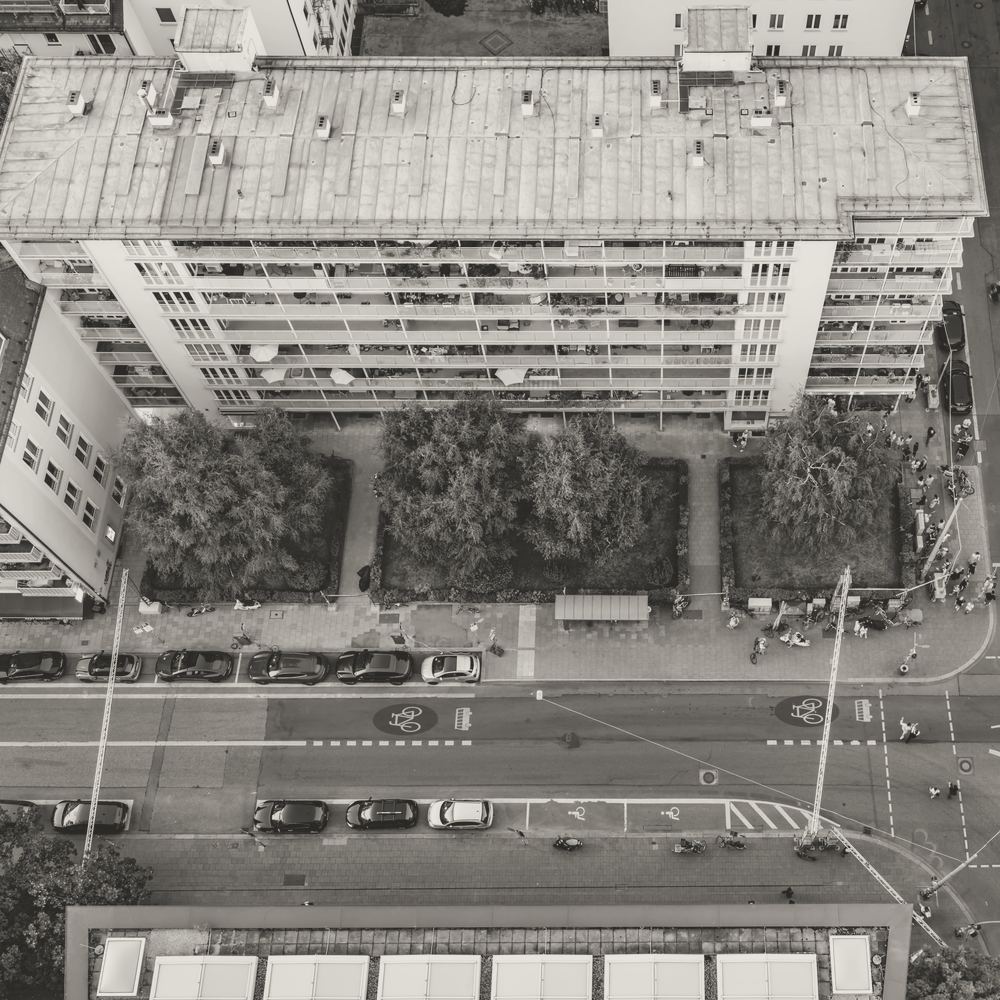
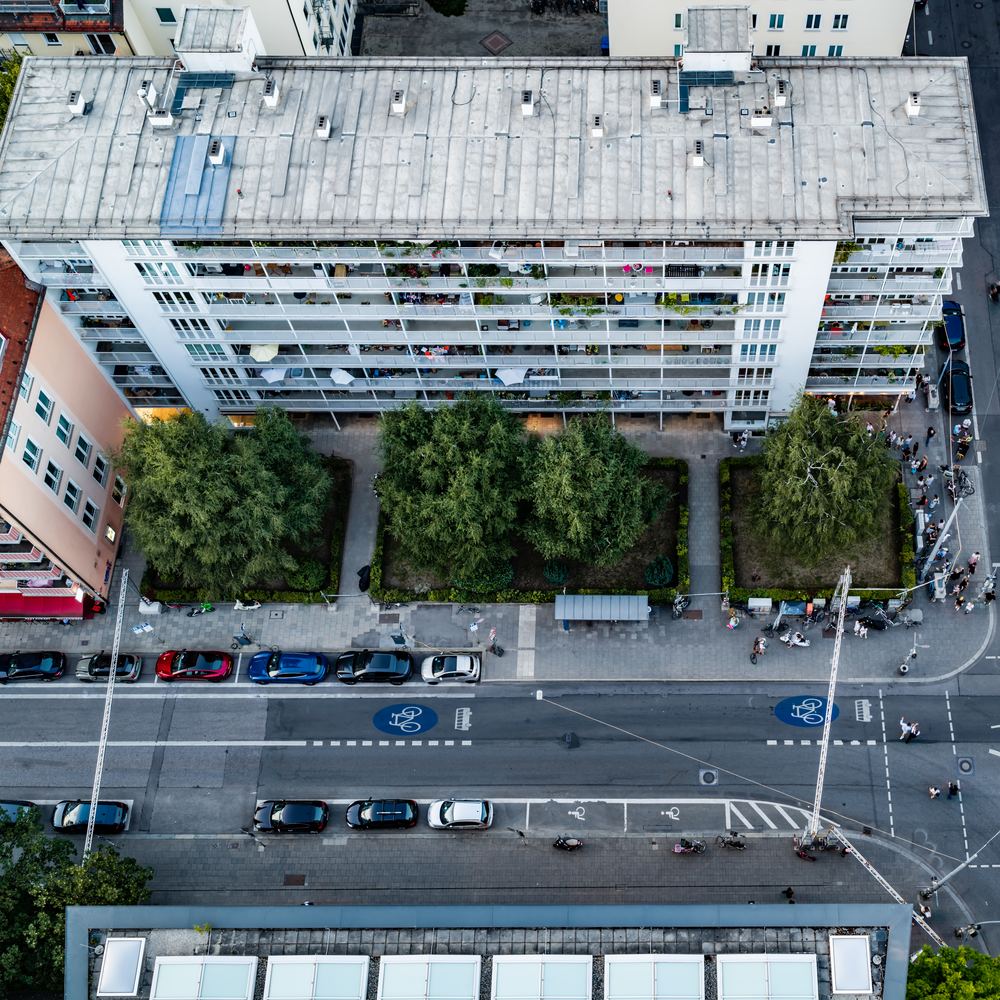
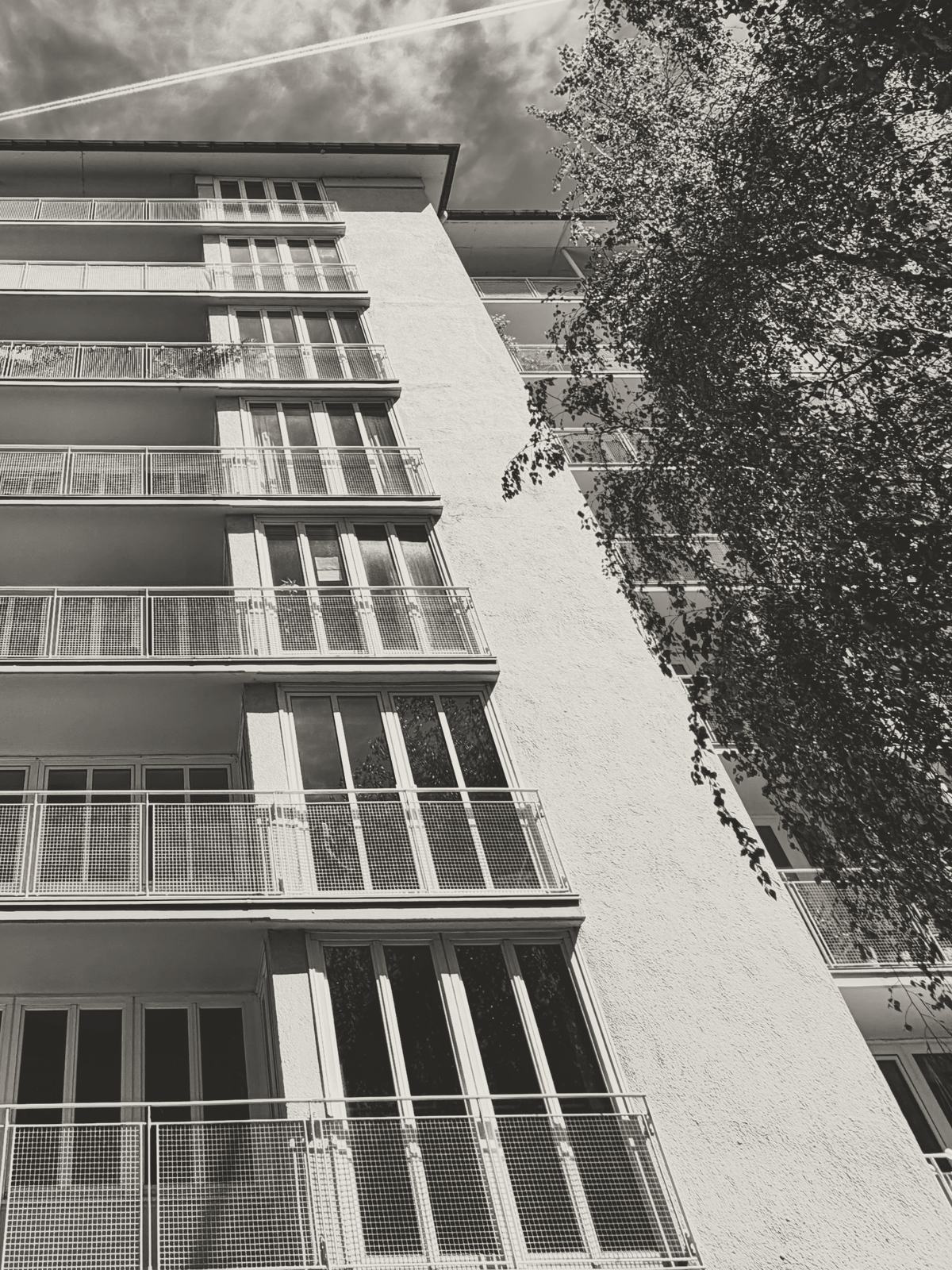
Munich's first residential high-rise, built 1950–1952 by Sep Ruf at the corner of Theresienstraße and Türkenstraße. Eight storeys, a filigree south façade, reinforced-concrete cross-wall construction. Listed since 1988 — and a station on the Munich Sep Ruf trail.
The construction history, source documents and contemporary voices are reconstructed after Irene Meissner: Sep Ruf 1908 | 1982, Deutscher Kunstverlag, 3rd edition, Berlin 2025, chapter "Wohnbauten 1950–1954" — the framing follows the Maxvorstadt Vibes editorial line.
Prehistory: from DAF land to model project
Until 1945 the corner plots at Theresienstraße/Türkenstraße belonged to the property portfolio of the Deutsche Arbeitsfront (DAF), the Nazi-era national labour organisation. After the war they passed to the Free State of Bavaria under Allied Control Council Directive No. 50; the state offered the ruined sites for sale or, where no adequate price could be achieved, on a hereditary building lease (Erbbaurecht).
In parallel, Robert Vorhoelzer — postal-architecture pioneer of the 1920s, reinstated as a professor at the Technical University of Munich after 1945 and appointed "Special Commissioner for Repair and Reconstruction" — had been commissioned by the Bavarian Ministry of Education in early 1946 to prepare an urban-planning study for Maxvorstadt and Schwabing. His proposal: a break with the dense late-19th-century perimeter block, replaced by a loose, green-permeated arrangement with set-back building lines.
The state found its developer in spring 1950. On 4 April the sites passed to the Verein zur Behebung der Wohnungsnot e.V., founded in Nuremberg in 1948 and from 1950 trading as Wohnbau-Treuhandgesellschaft mbH. The society had made a name for itself in Franconia with a financing model that was new to Germany: owner-occupied co-ownership. Sep Ruf served as deputy chair of the Munich branch as the society expanded into the Bavarian capital — architect and developer in personal union, a constellation that explains the speed of the months that followed.
Munich's first residential high-rise
Ruf's answer to the narrow corner plot was a slender eight-storey residential slab, set back behind the old building line. A continuous row of shops at ground-floor level; above, 42 flats organised as three-per-floor units with 51 to 68 m² of floor area, all oriented to the south. Floor-to-ceiling windows open the south façade into a single band of glass; a continuous balcony runs in front of it and turns the corner at the street junction.
At 23 metres the building bumped hard against the Munich tiered building ordinance (Staffelbauordnung) of 1904, which capped façade height to gutter line at 22 metres, prohibited buildings exceeding street width in height, and classed anything above five storeys as a high-rise. The government of Upper Bavaria issued the necessary dispensations — for the set-back rule as well as the number of storeys. The building application of 30 May 1950 was approved barely seven weeks later, on 19 July 1950.
The construction itself proceeded at the same pace. The shell stood after seven weeks; by April 1951 Munich's first residential high-rise was ready for occupation. The show flats were open from 7 to 15 April — furniture selection by Sep Ruf himself. Munich residents queued.
Construction and cost
Load-bearing structure in cross-wall construction (Schottenbauweise), walls of 32 cm poured concrete (Schüttbeton), short spans. The exterior delivers the visual counterpoint: filigree metal supports, slim reinforced-concrete balconies, a shallow projecting roof on metal posts. Ruf dispensed with central heating and a basement; oil stoves served the flats, and a single-storey rear annex took on utility rooms and garages.
The result: a unit-construction cost of just 38 DM per cubic metre of enclosed space. Purchase prices ran from 14,000 to 18,000 DM depending on layout and storey. Buyers paid one-fifth on moving in, then 80 to 100 DM monthly; after ten years the instalment was halved, after 27 years the flat passed free of debt into private ownership. The legal framework: the Housing Construction Act of 24 April 1950 — owner-occupation for broad social strata as a federal programme objective of the early post-war years.
Reception: „Glass box" or breakthrough?
The form was unknown in Bavaria up to that point. The only federal-wide precedent: the Grindelhochhäuser in Hamburg-Rotherbaum, twelve slab-blocks of nine to fourteen storeys erected from 1946 — formally far more radical than Ruf's Munich building.
Munich split. From the citizenry came the demand for "no revolution in building style"; the Süddeutsche Zeitung captured the mood on 3/4 March 1951 with the phrase „München muß München bleiben" ("Munich must remain Munich"). The label „Glaskasten" ("glass box") became the popular sneer for a building whose south side, free of visible window heads, ran from floor to ceiling in glass. The architectural critic Hans Eckstein took the opposite view: for him the completion of the building marked "the beginning of a contemporary urban order" for Munich. Vorhoelzer himself had praised Ruf's concept already in his expert report of 14 April 1950 as the very "loosening up along the principles of light, air, sun and a departure from block-perimeter building with its dead corners" that he had proposed for Maxvorstadt.
Comparable buildings of this modernity remained rare in Munich. The second standard work of the same lineage is the Kithan House on Maximiliansplatz, built in 1953 by Georg Brenninger — with the first curtain-wall glass façade in Munich. Public perception shifted only over the decades; today Ruf's slab reads as a self-evident part of the quarter.
Significance in Ruf's work
The building opens Ruf's most productive phase. There followed the Academy of Fine Arts Nuremberg (1952–1954), the Neue Maxburg in Munich (1954–1957, with Theo Pabst), the German Pavilion at Expo 58 in Brussels (with Egon Eiermann) and the Chancellor's Bungalow in Bonn (1963/64) for Ludwig Erhard. Ruf's canon is already present in the Theresienstraße building: transparency, floating horizontal layers, clear proportion, precise detail. Today it is a station on the City of Munich's Sep Ruf trail.
Listing and refurbishments
Entered on the Bavarian list of historic monuments in 1988. A heritage-compliant façade refurbishment took place in 2008, the balconies were refurbished in 2019/2020. For the 70th anniversary in 2021 — seventy years after first occupation — the Sep Ruf Society staged the programme "Sep-Ruf-Haus 70".
Bridge to today — what would make sense again
Seventy-five years after Ruf's residential high-rise, Munich is again in an acute housing shortage. Rents are among the highest in Germany, new-build volumes have collapsed, permit times are long. A nostalgic return to 1950 is out of the question — modern protective, environmental and participation rights are non-negotiable. But several structural answers that gave the Theresienstraße model its bite are worth a fresh look.
Procedural speed. Seven weeks from building application (30 May 1950) to permit (19 July 1950) — including dispensations for the height violation. Comparable administrative work takes years today. The federal and state initiatives gathered under the label "Bauturbo" (construction turbo) aim precisely at that — and have to find a new balance between acceleration and substantive protective rights. The Sep Ruf House is a reminder that fast official decisions were once the rule, not the exception.
Instalment-financed ownership. The developer demanded one-fifth on move-in, then 80 to 100 DM monthly, a halved rate after ten years, full ownership after 27. At heart this is a tiered rent-to-own model — back in discussion today under headings such as "Mietkauf für Familien" (rent-to-buy for families), cooperative permanent residential rights, or the owner-occupier schemes of municipal landlords such as Bavaria's BayernHeim. The structural problem of 1950 and 2026 is the same: the equity jump into purchase is too large for middle-class households. A staggered instalment was the answer then, and in modified form it is the answer now.
Public-benefit developer. The Verein zur Behebung der Wohnungsnot was not a profit-driven investor but a construction tied back to its residents. Since 1 January 2025 the new "Wohngemeinnützigkeit" (public-benefit housing status) is anchored in the German Corporation Tax Act: public-benefit rental-housing providers receive tax privileges in exchange for social and allocation commitments. Whether the instrument develops real bite will depend on the funding architecture of the states — Bavaria has room to manoeuvre here.
Simple building. Cross-wall construction with 32 cm poured concrete, no basement, oil stoves in place of central heating, a rear utility annex for services and garages: a deliberate dispensing with standard that pushed the cubic-metre price down to 38 DM. TU Munich has for years been testing exactly this approach under the title "Einfach Bauen" (Simple Construction, chair of Florian Nagler) — robust solid construction, slim building services, clear structure. The parallel debate over loosening the German Building Energy Act (GEG) and the DIN-standard load on housing construction points in the same direction. Ruf's house has been demonstrating for seventy-five years that such buildings need not be architecturally poorer — quite the opposite.
Height and density. Twenty-three metres — above the Munich tiered building ordinance of 1904, but possible by special permit. Since the citizens' referendum of 2004 the city effectively caps new residential high-rises at 100 metres (the height of the Frauenkirche). Munich's ongoing high-rise debate is showing again that targeted densification at urbanistically defensible sites is once more politically negotiable. Ruf's house is a well-aged argument in favour: a single, precisely placed building above the eaves line can strengthen a quarter rather than break it — if it carries design-wise.
Loose setting. Vorhoelzer's idea — set back the building line, let in light and air — was decisive in 1950 for getting the project approved. Echoes today: the debate around courtyard infill and roof additions, the planned widening of individual Maxvorstadt axes for cycling and walking, the concept of "green courtyards". The Sep Ruf House shows that urban repair and densification need not be in conflict; both can flow from the same stance — precise measure, not maximum exploitation.
What is transferable from the Theresienstraße model into today's debate is therefore not a nostalgic block but a bundle: a real, instalment-financed path to home ownership for middle-class buyers, shorter and more honestly reasoned procedures, a constructive turn to simple building, a public-benefit developer approach for rental housing, and the willingness to grant height to individual buildings at strategic locations. What is not transferable: the procedural pace of the early Federal Republic without modern protective rights, and the rapid disposal of state land formerly confiscated from a National Socialist organisation. The lesson of the Theresienstraße building is one of tools — not of dispensing with standards, but of the right bundle of them.
Location.
Approach over Maxvorstadt — corner Theresienstraße/Türkenstraße. Ruf's residential slab sits as the gateway into Munich's museum quarter, a clearly visible free-standing accent between Academy of Fine Arts, Pinakotheken and Türkenstraße.
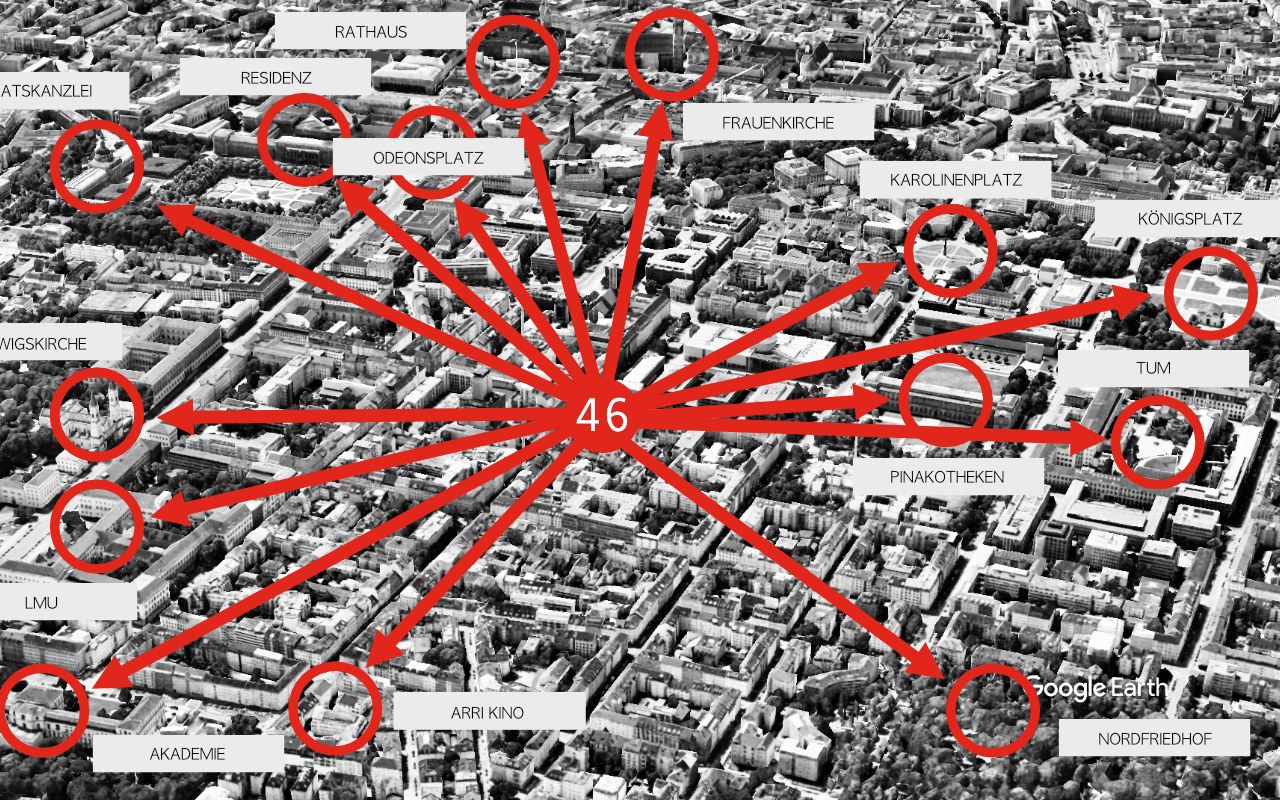
Location map — Theresienstraße 46 in the quarterBefore the war the corner plot carried the address Türkenstraße 19; with the new building the house number was withdrawn, and the house has since been listed only as Theresienstraße 46/48. Both streets have their own portraits: Theresienstraße · Türkenstraße.
From the Sep Ruf House the main sites of Maxvorstadt and adjacent Old Town lie a few minutes' walk away — the Pinakotheken, Königsplatz, the LMU, the Academy of Fine Arts, Odeonsplatz, the Frauenkirche and the Residenz. The English Garden is less than 500 metres away.
Words.
Contemporary voices from press and official files, located via Meissner 2025 (chapter "Wohnbauten 1950–1954"). Original German quotations, English translation in brackets.
„Auflockerung nach den Grundsätzen von Licht, Luft, Sonne und Abkehr von der Blockbebauung mit den toten Winkeln." („Loosening up along the principles of light, air, sun and a departure from block-perimeter building with its dead corners.")— Robert Vorhoelzer · expert report on the project, 14 April 1950
„Keine Revolution des Baustils." („No revolution in building style.")— Munich citizens' voices, quoted in the press, 13 June 1951
„München muß München bleiben." („Munich must remain Munich.")— Süddeutsche Zeitung, 3/4 March 1951
„Glaskasten." („Glass box.")— Contemporary press criticism, 1951
„Beginn einer zeitgemäßen städtebaulichen Ordnung Münchens." („The beginning of a contemporary urban order for Munich.")— Hans Eckstein · architectural critic, 1951
„Anyone walking up Türkenstraße from Brienner Straße towards the Academy of Fine Arts should raise their gaze."— Maxvorstadt Vibes · spot entry on the Sep Ruf House
In pictures.
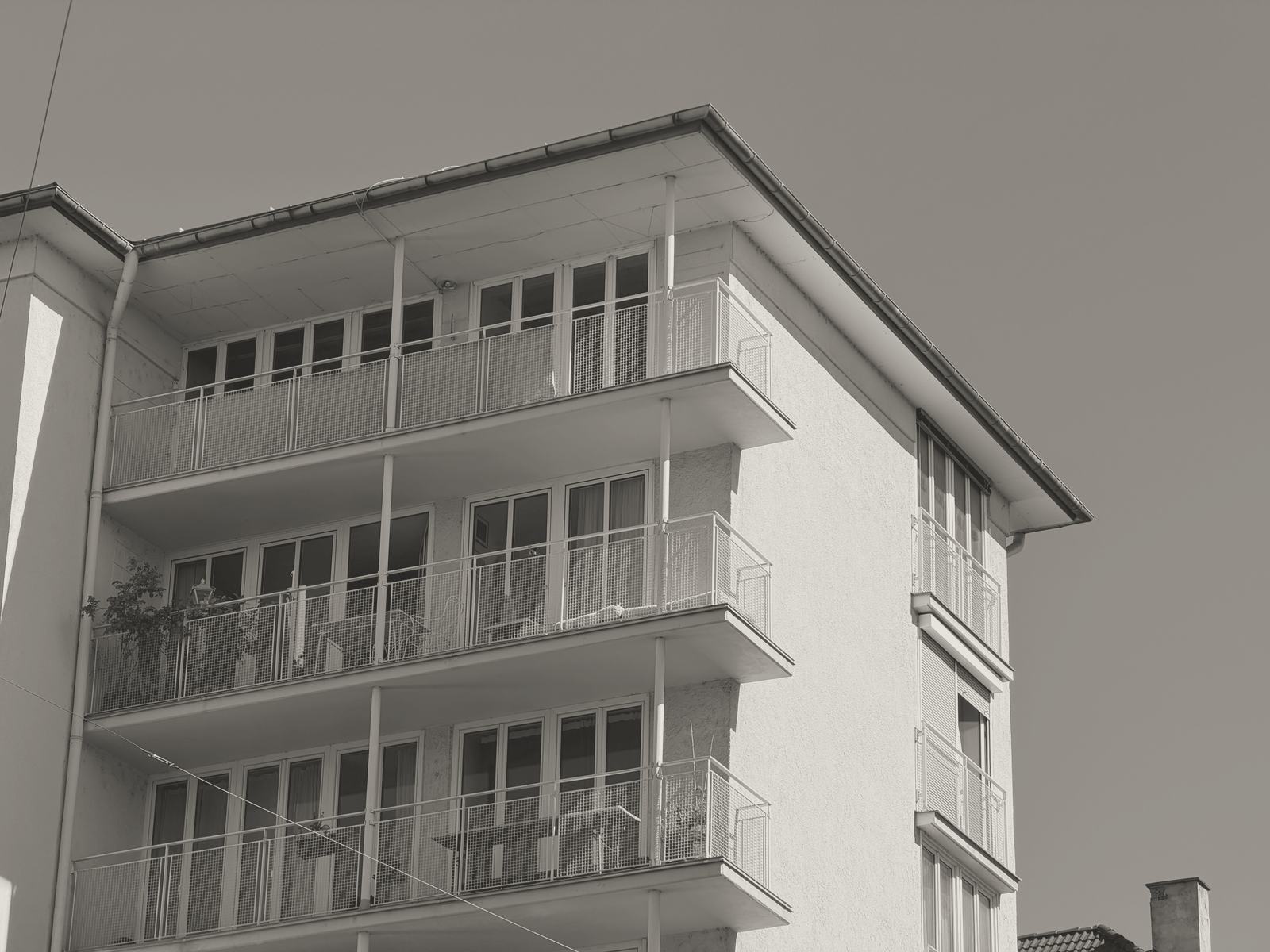 Balconies at the corner
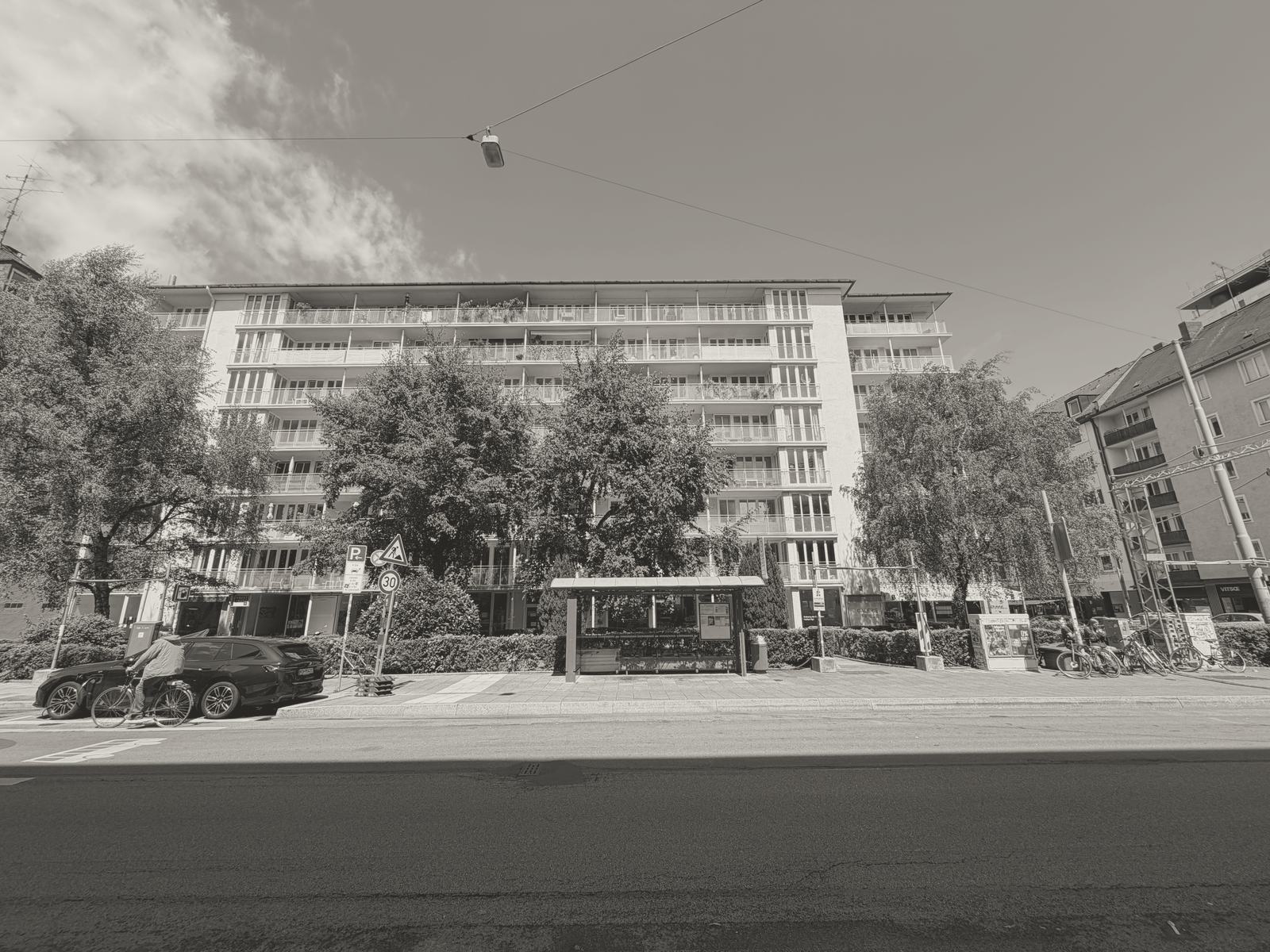 Street front on Theresienstraße
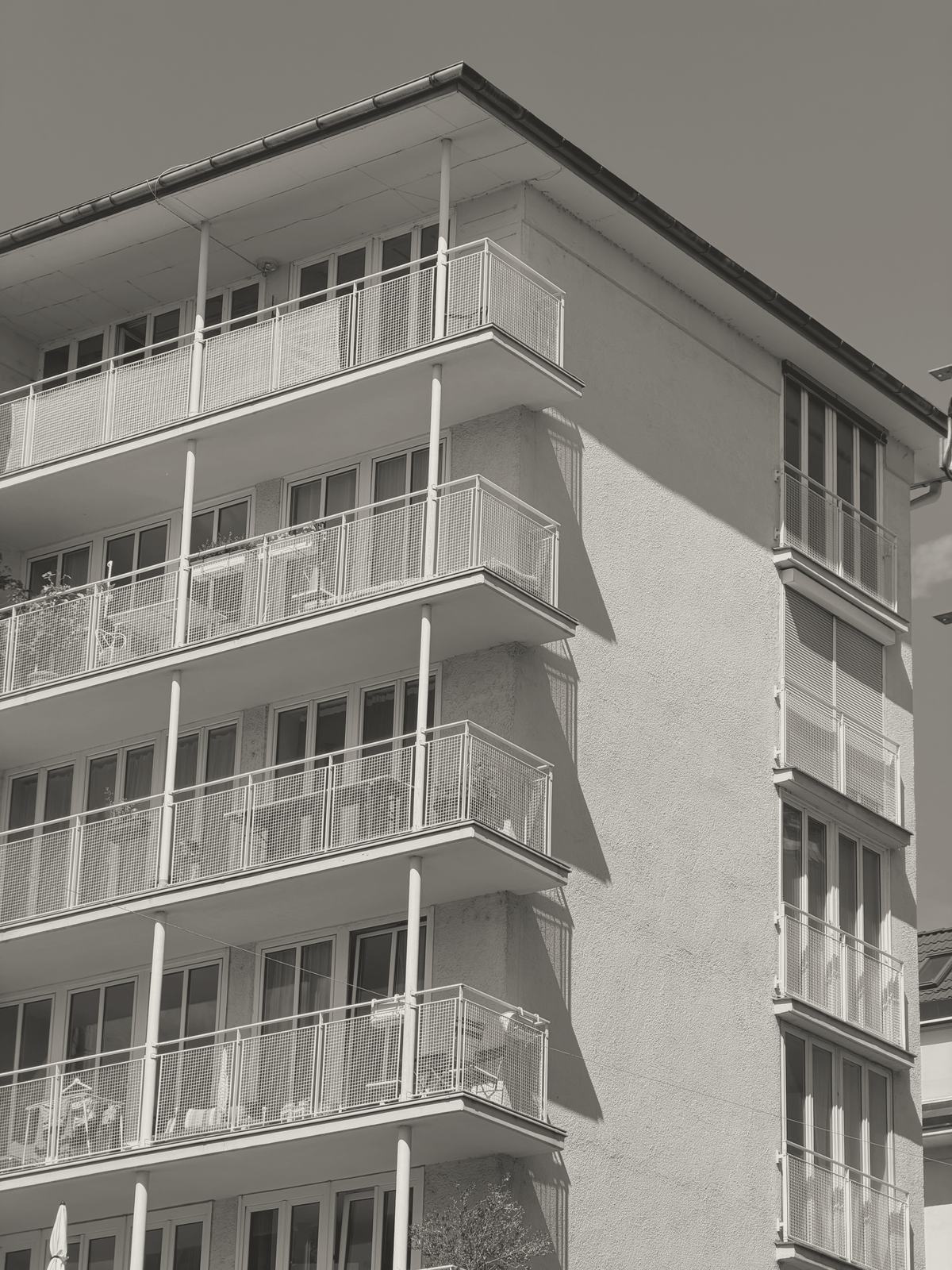 Balconies seen from below
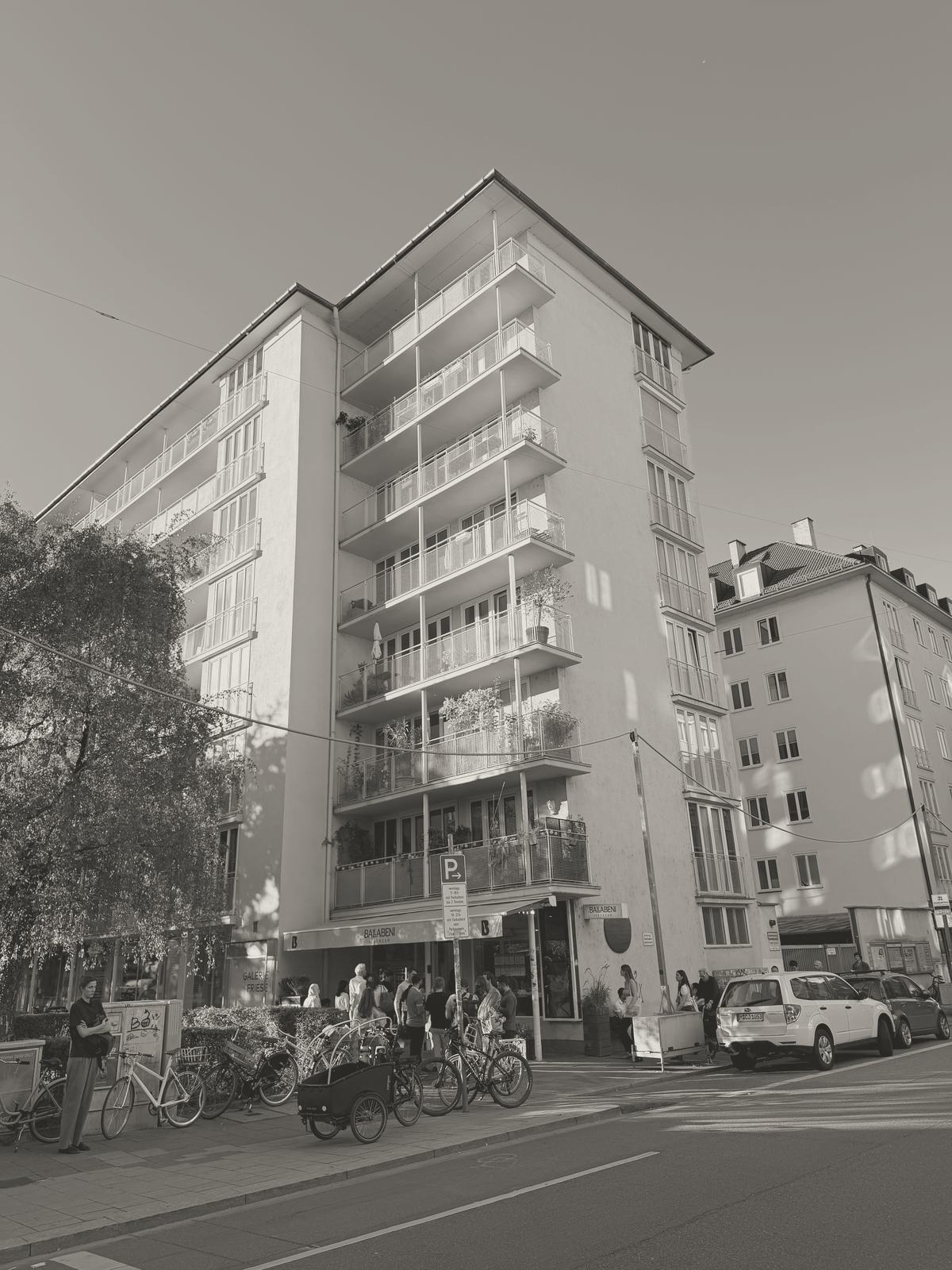 Full view from the street
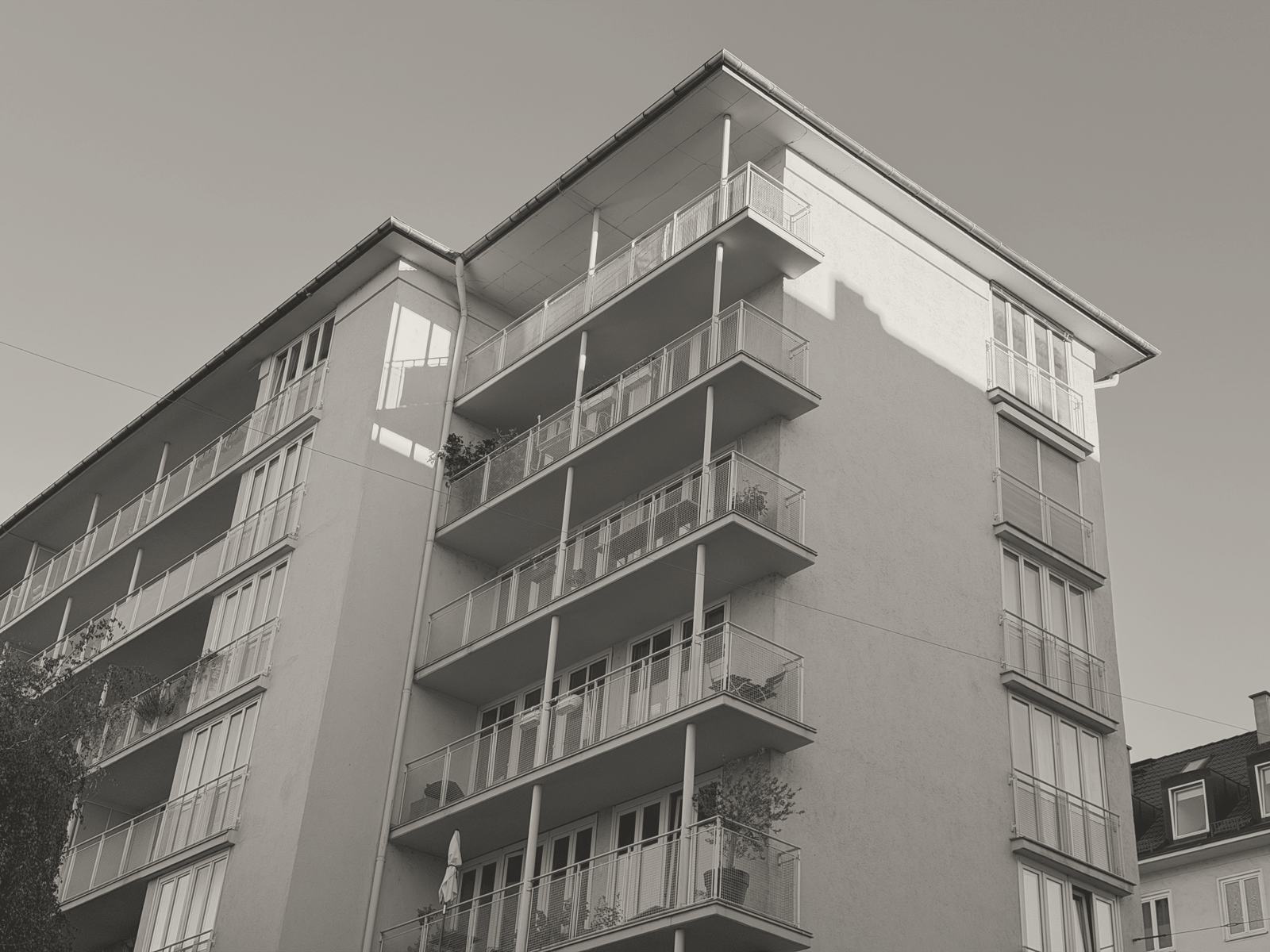 Evening light on the façade
 Grid façade
Photos: Thomas Prüm, 2025–2026
Further reading.
sepruf.
maxvorstadtvibes.de
The documentation of the building (in German): history and architecture in detail, Sep Ruf's life and work, drone photographs, the Alpine view from the balcony and three flyovers of the Maxvorstadt.
Back to
the map of all
nine sites.
Königsplatz, Ehrentempel, Führerbau, Verwaltungsbau, NS-Doku, Schelling-Salon, Osteria, Prinz-Carl-Palais, Consulate General.